


The Iceberg Model in Mindfulness Teaching: Why What Lies Beneath the Surface Matters

The Iceberg Model and Mindfulness Teaching

The Hidden Foundations of Transformative Learning

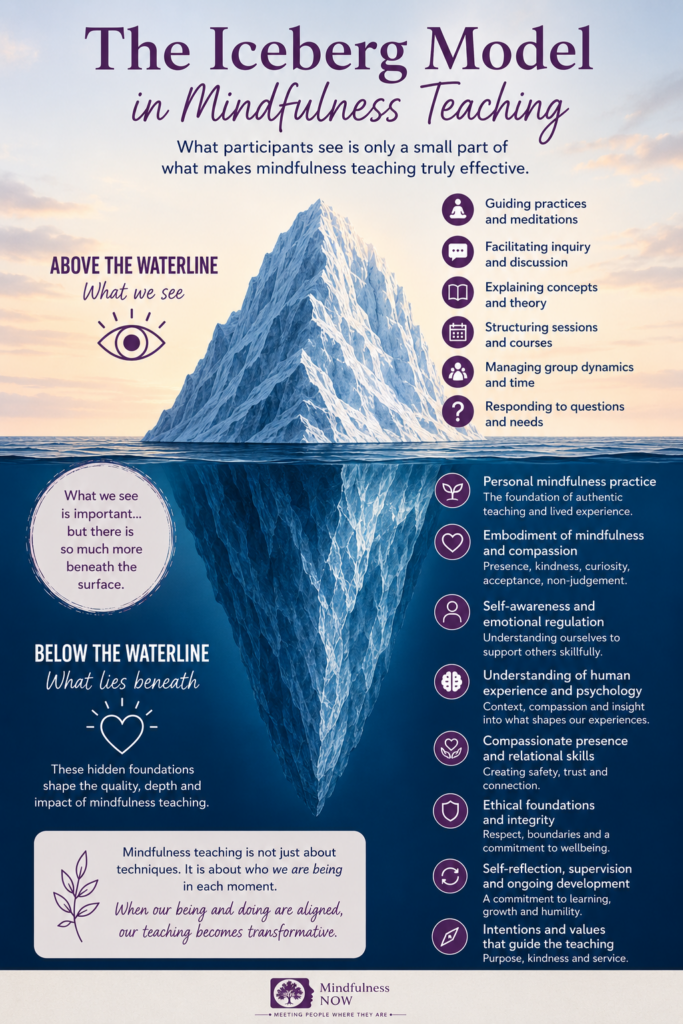
When people attend a mindfulness course, they naturally focus on what they can see. They experience guided meditations, group discussions, practical exercises, and opportunities for reflection. These visible elements are important, but they represent only a small part of what makes mindfulness teaching truly effective.

The Iceberg Model offers a helpful way of understanding this.

Like an iceberg, only a small portion of mindfulness teaching is visible above the surface. Beneath the waterline lies a much larger foundation that supports everything a teacher does. It is this hidden foundation that often determines the depth and quality of participants’ learning experiences.

What We See Above the Waterline

The visible aspects of mindfulness teaching include:

  • Guiding mindfulness and compassion practices
  • Facilitating inquiry and discussion
  • Explaining key concepts and theories
  • Creating a structured learning experience
  • Supporting participants through exercises and reflections
  • Managing group dynamics and learning needs

These skills are essential. They help participants engage with mindfulness in practical and meaningful ways.

However, mindfulness teaching is far more than the delivery of techniques. A meditation script alone does not create transformation. The quality of the teacher’s presence and embodiment plays an equally important role.

The Hidden Foundations Below the Surface

At Mindfulness Now, we recognise that effective teaching emerges from qualities that may not always be visible but are deeply felt by participants.

Personal Practice

A mindfulness teacher’s personal practice forms the bedrock of their teaching.

Through regular mindfulness and compassion practice, teachers develop a deeper understanding of their own thoughts, emotions, habits, and patterns of reactivity. This lived experience enables them to teach with authenticity rather than simply sharing information from books or training manuals.

Participants often recognise when a teacher is speaking from experience. There is a sense of genuineness that cannot be manufactured.
 

Embodiment

Embodiment is one of the most important aspects of mindfulness teaching.

Rather than simply explaining mindfulness, the teacher demonstrates it through their way of being. Embodiment may be reflected in:

  • Present-moment awareness
  • Kindness and compassion
  • Patience
  • Curiosity
  • Acceptance
  • Emotional balance
  • Authenticity

Participants learn not only from what the teacher says but also from how the teacher relates to themselves, the group, and whatever arises in the moment.

In many ways, the teacher becomes a living expression of the practice.


Compassionate Presence

Mindfulness Now places particular emphasis on the integration of mindfulness and compassion.

Compassionate presence allows teachers to meet participants with warmth, understanding, and acceptance. This creates the psychological safety needed for meaningful exploration and growth.

When people feel seen, heard, and accepted, they are often more willing to engage honestly with their experience.


Self-Reflection and Ongoing Development

Mindfulness teaching is not a destination but an ongoing journey.

Effective teachers continue to reflect on their practice, seek supervision, engage in continuing professional development, and remain open to learning from their own experience.

The willingness to remain a learner is one of the qualities that strengthens teaching over time.


Compassionate Inquiry: Exploring Beneath the Surface

The Iceberg Model also connects beautifully with the process of inquiry.

Within Mindfulness Now training, inquiry is not simply a discussion about meditation experiences. It is a compassionate exploration that helps participants become curious about what lies beneath their immediate thoughts, reactions, and behaviours.

Just as much of an iceberg remains hidden below the waterline, much of our inner experience operates beneath conscious awareness.

Through mindful inquiry, participants begin to notice:

  • Habitual thinking patterns
  • Emotional responses
  • Automatic reactions
  • Underlying beliefs
  • Unmet needs
  • Self-critical tendencies

By bringing these experiences into awareness with kindness and curiosity, new possibilities for understanding and change can emerge.

The Relationship Between Being and Doing

The Iceberg Model reminds us of a central principle within mindfulness teaching: the balance between being and doing.

Many educational approaches focus primarily on what a teacher does. Mindfulness teaching values skillful action, but it also recognises the importance of how a teacher is being.

Participants often remember less about the specific words that were spoken and more about how they felt in the teacher’s presence.

When mindfulness is embodied, teaching becomes more than instruction. It becomes a relational experience that invites participants to discover their own capacity for awareness, compassion, and wellbeing.

A Model for Teachers and Students Alike

The Iceberg Model is not only relevant for mindfulness teachers. It also offers a powerful framework for understanding our own personal growth.

We often focus on visible behaviours while overlooking the deeper patterns, beliefs, emotions, and attitudes that shape our lives. Mindfulness practice invites us to gently explore what lies beneath the surface.

As awareness develops, we begin to understand ourselves more fully and respond to life with greater wisdom and compassion.

At Mindfulness Now, we believe that transformative teaching grows from transformative practice. The most powerful aspects of mindfulness teaching are often invisible, yet they are felt in every interaction, every moment of presence, and every act of compassionate awareness.

Like the hidden mass of an iceberg, these deeper qualities provide the foundation upon which meaningful learning and lasting change can emerge.

Further Reading

Foundational Mindfulness Teaching

Crane, R. (2017). Mindfulness-Based Cognitive Therapy
A comprehensive exploration of mindfulness teaching, embodiment, and the development of mindfulness teachers.
https://www.routledge.com/Mindfulness-Based-Cognitive-Therapy/Crane/p/book/9781138647440

Crane, R., Soulsby, J., Kuyken, W., Williams, J.M.G., & Eames, C. (2013). The Bangor, Exeter & Oxford Mindfulness-Based Interventions Teaching Assessment Criteria (MBI:TAC)
A key framework highlighting the importance of embodiment in mindfulness teaching.
https://mbitac.bangor.ac.uk


Embodiment in Mindfulness Teaching

McCown, D., Reibel, D., & Micozzi, M. (2010). Teaching Mindfulness
Explores the relational and embodied aspects of mindfulness teaching.
https://link.springer.com/book/10.1007/978-0-387-09484-7

Mindfulness-Based Interventions: Teaching and Learning Companion
Resources exploring mindfulness embodiment and teaching practice.
https://mindfulnessteachersuk.org.uk


Compassion and Inquiry

Karen Atkinson (2018). Compassionate Mindful Inquiry in Therapeutic Practice
An exploration of compassionate inquiry and what lies beneath the surface of human experience.
https://www.amazon.co.uk/Compassionate-Mindful-Inquiry-Therapeutic-Practice/dp/0367336765

Gilbert, P. (2010). Compassion Focused Therapy
Provides valuable insights into compassion, emotional regulation, and the cultivation of self-compassion.
https://www.compassionatemind.co.uk


Personal Practice and Embodiment

Kabat-Zinn, J. (2013). Full Catastrophe Living
A foundational text on mindfulness practice and the attitudes that underpin mindful living.
https://www.mindfulnesscds.com/products/full-catastrophe-living

Nhat Hanh, T. (2015). The Miracle of Mindfulness
A timeless introduction to living mindfulness through everyday experience.
https://plumvillage.org/about/thich-nhat-hanh


Mindfulness Now

Mindfulness Now Teacher Training
Explore how mindfulness, compassion, embodiment, and inquiry are integrated within the Mindfulness Now approach.
https://mindfulnessnow.org.uk


Recommended Reflection

As you consider the Iceberg Model, reflect on this question:

What aspects of my teaching, leadership, or personal practice are visible above the surface, and what deeper qualities beneath the surface are supporting them?

Often, the most transformative aspects of mindfulness teaching are not what participants see, but what they experience through the teacher’s presence, compassion, and authenticity.


The Future of Mindfulness Teaching: The N.I.A. Language Model and the Three Cs

The Future of Mindfulness Teaching: The N.I.A. Language Model and the Three Cs

Mindfulness teaching has undergone significant evolution over the past three decades. What began as a largely standardised approach to teaching meditation and awareness practices has developed into a far richer understanding of how people experience mindfulness.

Today, mindfulness teachers are increasingly recognising that effective teaching is not simply about delivering practices. It is about creating environments where all learners can engage safely, meaningfully, and in ways that respect their individual needs.

At the heart of this evolution lies a simple but profound realisation:

Language matters.

The words we choose can create safety or uncertainty.

They can foster inclusion or unintentionally create barriers.

They can support autonomy and understanding or leave learners feeling confused, overwhelmed, or excluded.

As our understanding of trauma, accessibility, and neurodiversity continues to grow, a new frontier is emerging within mindfulness teaching—one that places communication at the centre of accessible practice.

This is the foundation of the N.I.A. Language Model™ and the Three Cs of Neurodiversity-Informed Mindfulness Language™.

Together they form what we believe is the future of accessible mindfulness teaching.

Why Mindfulness Language Needs to Evolve

Traditionally, mindfulness teaching has often relied on instructions, metaphorical language, imagery, and assumptions about how people engage with practice.

For many learners these approaches are helpful.

For others they can create challenges.

Some participants may have experienced trauma and find directive language overwhelming or disempowering.

Others may be neurodivergent and find abstract metaphors, ambiguous instructions, or lengthy explanations difficult to process.

Some may simply learn differently.

The reality is that mindfulness teachers are working with increasingly diverse groups of people.

If mindfulness is truly to be accessible to everyone, the language we use must evolve to reflect that diversity.

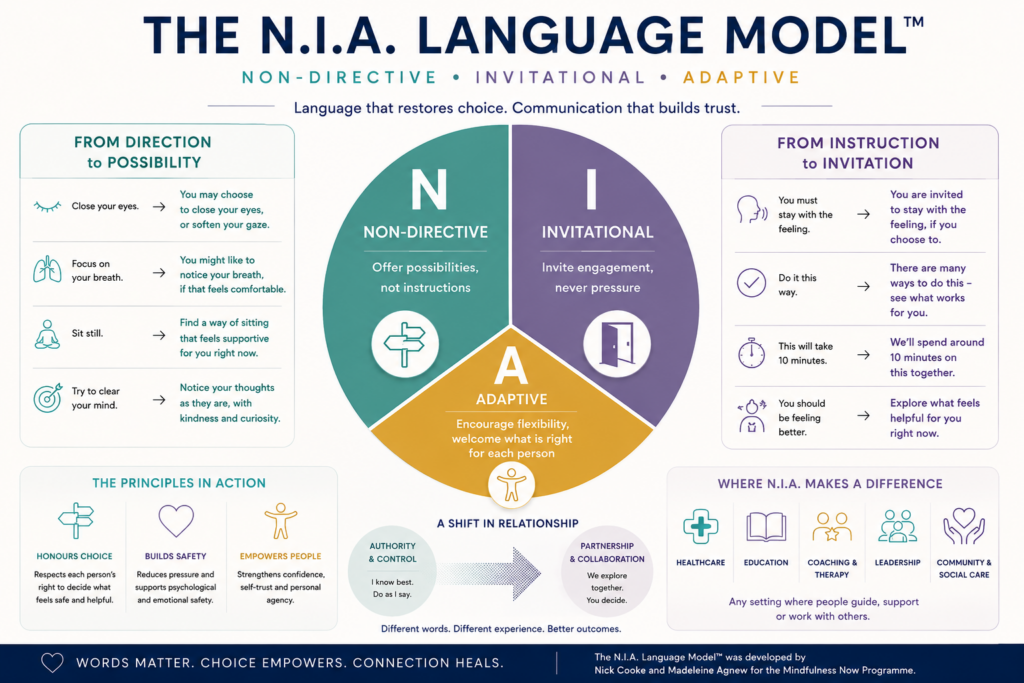
At its core, the N.I.A. Language Model restores agency to the learner.

It moves mindfulness away from prescription and towards participation.

The N.I.A. Language Model™

Developed by Nick Cooke and Madeleine Agnew, the N.I.A. Language Model™ was created to support a more accessible, trauma-sensitive approach to mindfulness communication.

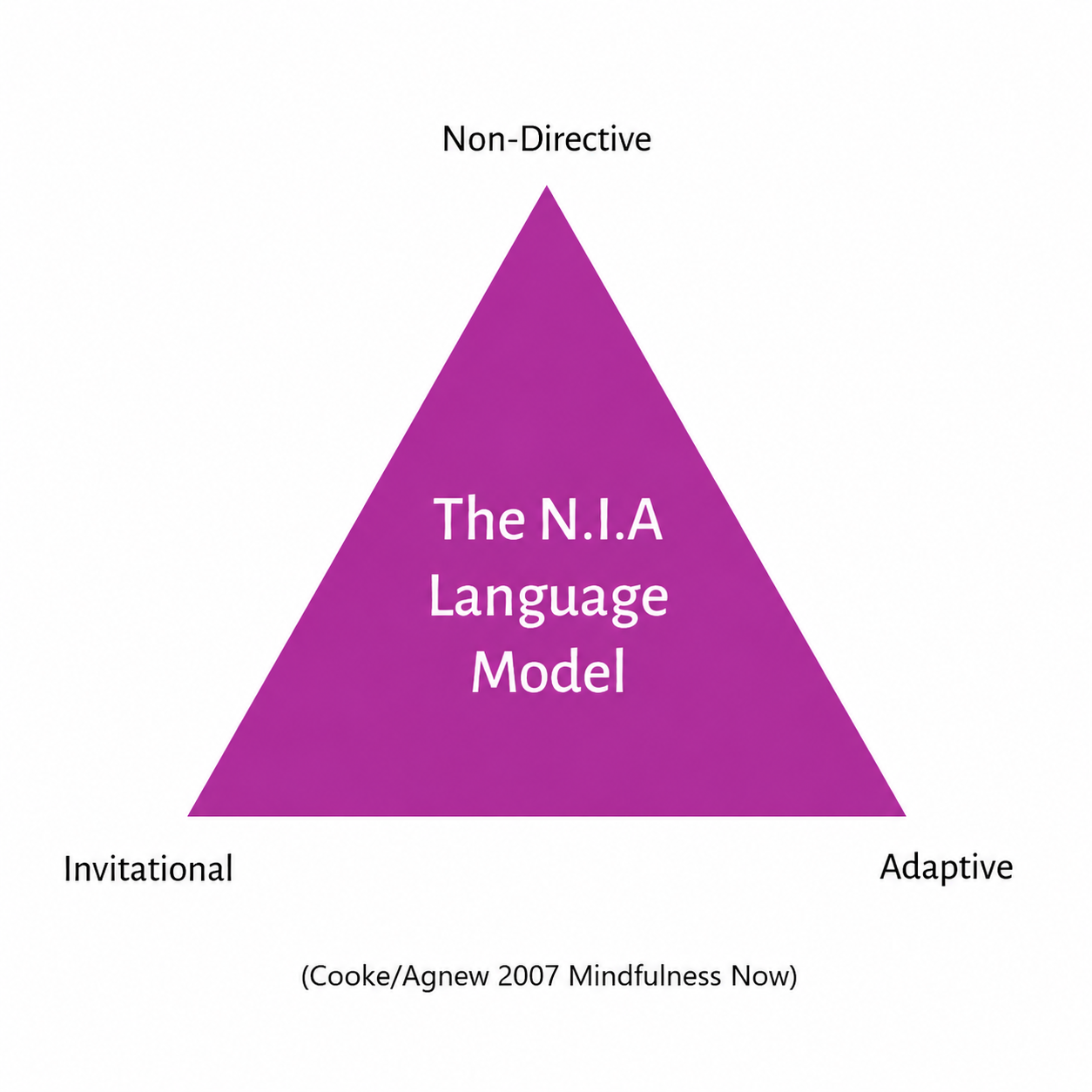
N.I.A. stands for:

Non-Directive

Rather than telling participants what they should experience or how they must engage, teachers offer possibilities and options.

Invitational

Mindfulness is offered through invitations rather than commands, encouraging curiosity, exploration, and personal choice.

Adaptive

Teaching is responsive to individual needs, recognising that different learners may engage with mindfulness in different ways.

Together these principles help create environments that support autonomy, psychological safety, and genuine choice.

The Three Cs of Neurodiversity-Informed Mindfulness Language

As awareness of neurodiversity has grown, another important question has emerged:

How do we ensure that mindfulness language is not only choice-based, but also easy to understand?

This question led to the development of the Three Cs of Neurodiversity-Informed Mindfulness Language™.

The Three Cs provide a simple but powerful framework for accessible communication.

Clear

Use language that is straightforward, understandable, and easy to follow.

Concrete

Use language that is specific, literal, and observable wherever possible.

Concise

Use only the words that are needed, reducing unnecessary cognitive load and complexity.

These principles are particularly important for many neurodivergent learners, including some autistic individuals and those with different information-processing styles.

However, the benefits extend far beyond neurodiversity.

Most people find clear, concrete, and concise communication easier to engage with.

Why the N.I.A. Model and the Three Cs Work Together

The N.I.A. Language Model and the Three Cs address two different but equally important aspects of communication.

The N.I.A. principles help us consider:

How we offer mindfulness practice.

The Three Cs help us consider:

How we communicate mindfulness practice.

One without the other is incomplete.

Choice without clarity can create confusion.

Clarity without choice can feel controlling.

When combined, these frameworks create a communication style that is:

  • Trauma-sensitive
  • Neurodiversity-informed
  • Accessible
  • Inclusive
  • Flexible
  • Person-centred


Accessibility Is No Longer an Optional Extra

Historically, accessibility has often been viewed as an adaptation made for a small number of participants.

The future of mindfulness teaching requires a different perspective.

Accessibility should not sit at the edges of teaching.

Accessibility should sit at its centre.

The N.I.A. Language Model and the Three Cs represent a shift away from asking learners to adapt to mindfulness.

Instead, mindfulness adapts to meet the needs of learners.

This is not about lowering standards.

It is about removing unnecessary barriers.

It is about recognising that diversity is not an exception to mindfulness teaching—it is the reality of mindfulness teaching.


A New Frontier for Mindfulness Teachers

As mindfulness teachers, we are continually learning.

The growing understanding of trauma-informed practice, neurodiversity, inclusion, and accessibility is reshaping the way mindfulness is taught around the world.

The N.I.A. Language Model™ and the Three Cs of Neurodiversity-Informed Mindfulness Language™ provide practical frameworks for responding to this evolution.

They help teachers communicate with greater sensitivity, clarity, flexibility, and accessibility.

Most importantly, they help ensure that mindfulness remains available to everyone.

Because mindfulness is not truly accessible until its language is accessible.

And when we combine choice with clarity, flexibility with understanding, and inclusion with belonging, we create something powerful:

Accessible mindfulness for all.

The N.I.A. Language Model™ and the Three Cs of Neurodiversity-Informed Mindfulness Language™ were developed by Nick Cooke and Madeleine Agnew through Mindfulness Now as part of an ongoing commitment to accessible, trauma-sensitive and neurodiversity-informed mindfulness teaching.

References & Further Information

Professional Standards and Best Practice

Mindfulness Teachers Association (MTA)
https://mindfulnessteachers.org.uk

The UK’s largest professional register of accredited mindfulness teachers, promoting ethical, evidence-based, and inclusive mindfulness teaching standards.

British Association of Mindfulness-Based Approaches (BAMBA)
https://bamba.org.uk

The UK’s professional body for mindfulness practitioners, teachers, and training organisations, promoting safe, ethical, and evidence-based mindfulness teaching.

BAMBA Professional Standards
https://bamba.org.uk/professional-standards/

A framework outlining recognised standards for mindfulness teachers, including training, personal practice, supervision, retreat participation, and continuing professional development.

BAMBA Good Practice Guidelines
https://bamba.org.uk/good-practice-guidelines/

Widely recognised guidance supporting safe, ethical, and inclusive mindfulness teaching and training.


Mindfulness Research and Teacher Development

Oxford Mindfulness Foundation
https://www.oxfordmindfulness.org

Research, training, and resources supporting evidence-based mindfulness approaches.

Centre for Mindfulness Research and Practice (Bangor University)
https://www.bangor.ac.uk/mindfulness

One of the leading centres for mindfulness research, training, and teacher development.

Mindfulness Network
https://www.mindfulness-network.org

Resources, supervision, mentoring, and continuing professional development opportunities for mindfulness teachers.


Neurodiversity and Inclusive Communication

National Autistic Society
https://www.autism.org.uk

Guidance on autism, communication styles, inclusion, and accessibility.

Neurodiversity Hub
https://www.neurodiversityhub.org

Resources supporting inclusive learning and communication practices across diverse neurotypes.

ADHD Foundation
https://www.adhdfoundation.org.uk

Information and resources supporting neurodiversity-informed approaches to learning and wellbeing.


Trauma-Informed Practice

Trauma Informed UK
https://www.tiuk.org

Training and resources on trauma-informed practice across health, education, and wellbeing settings.

Beacon House Trauma Team
https://beaconhouse.org.uk

Accessible resources exploring trauma, nervous system regulation, attachment, and psychological safety.

Centre for Trauma-Informed Mindfulness
https://traumainformedmindfulness.org

Resources and perspectives on integrating mindfulness with trauma-informed approaches.


Accessibility and Inclusion

Scope
https://www.scope.org.uk

Information and guidance on disability inclusion and accessibility.

Equality and Human Rights Commission
https://www.equalityhumanrights.com

Guidance on equality, accessibility, and inclusive practice.


International Mindfulness Standards

International Mindfulness Teachers Association (IMTA)
https://imta.org

An international organisation promoting standards, accreditation, and professional development for mindfulness teachers worldwide.


Learn More About Accessible Mindfulness Language

Mindfulness Now
https://mindfulnessnow.org.uk

Training, resources, and professional development in mindfulness teaching, including the N.I.A. Language Model™ and the Three Cs of Neurodiversity-Informed Mindfulness Language™.


Suggested Closing Statement

The N.I.A. Language Model™ and the Three Cs of Neurodiversity-Informed Mindfulness Language™ were developed by Nick Cooke and Madeleine Agnew through Mindfulness Now as part of an ongoing commitment to accessible, trauma-sensitive, and neurodiversity-informed mindfulness teaching. These frameworks continue to evolve alongside emerging understanding of inclusion, communication, and best practice within the mindfulness profession.

The N.I.A. Language Model: The New Universal Language of Accessible Mindfulness

The N.I.A. Language Model: The New Universal Language of Accessible Mindfulness

For many years, mindfulness teaching has focused on helping people cultivate awareness, presence, and compassion. Yet as the field has grown, an important question has emerged:

Who is mindfulness truly accessible to?

While mindfulness is often presented as a universal practice, the language used by teachers can unintentionally exclude, marginalise, or even retraumatise some learners. Instructions that assume certain experiences, abilities, beliefs, or levels of emotional safety can create barriers rather than pathways into practice.

This challenge led to the development of the N.I.A. Language Model—a framework designed to make mindfulness teaching genuinely inclusive, accessible, and responsive to the diverse needs of all learners.

Today, the N.I.A. Language Model has become recognised as the universal language of accessible mindfulness teaching. It represents a new frontier in mindfulness education, placing choice, flexibility, and accessibility at the centre of practice.

Why the N.I.A. Language Model Was Developed

The development of the N.I.A. Language Model emerged from a growing understanding that mindfulness is not experienced in the same way by everyone.

Every learner arrives with their own:

  • Life experiences
  • Cultural background
  • Physical abilities
  • Neurodiversity
  • Mental health history
  • Personal beliefs
  • Previous learning experiences

Traditional mindfulness language often assumes that participants can comfortably close their eyes, focus on bodily sensations, remain still, or explore difficult emotions. For many people, these invitations may feel supportive. For others, they may feel overwhelming, unsafe, or inaccessible.

Research and lived experience have increasingly shown that mindfulness teaching must move beyond a “one-size-fits-all” approach.

The N.I.A. Language Model was developed to address this need.

Its purpose is simple:

To ensure that mindfulness can be safely and meaningfully accessed by all people, regardless of background, circumstance, identity, or previous experience.

Developed by Nick Cooke and Madeleine Agnew, the N.I.A. Language Model was created to make mindfulness teaching more accessible, inclusive, and choice-led for all learners.

Accessibility Is Not an Optional Extra

Historically, accessibility has often been treated as an adaptation added after a course has been designed.

The N.I.A. approach challenges this thinking.

Accessibility is not something that sits on the edge of mindfulness teaching.

Accessibility is the foundation.

The model encourages teachers to use language that provides genuine options rather than instructions that imply there is only one correct way to practise.

Instead of saying:

“Close your eyes and focus on your breath.”

A N.I.A.-informed teacher might say:

“If it feels comfortable, you might choose to close your eyes, soften your gaze, or simply look around the room. You may notice your breath or any other experience that feels supportive right now.”

The difference may appear subtle, but it is profound.

The learner remains in control.

The learner retains agency.

The learner has choice.

Preventing Retraumatisation Through Choice

One of the most important reasons for developing the N.I.A. Language Model was the recognition that mindfulness practices can sometimes unintentionally contribute to retraumatisation.

For individuals who have experienced trauma, certain instructions may trigger distressing memories, sensations, or emotional responses.

Without accessible language, learners may feel:

  • Unsafe
  • Overwhelmed
  • Pressured
  • Excluded
  • Misunderstood
  • Marginalised

When mindfulness is presented as something that must be done in a particular way, participants can feel that they are “failing” if that approach does not work for them.

The N.I.A. Language Model replaces prescription with invitation.

It creates space for learners to engage in ways that feel appropriate and safe for them.

Rather than demanding compliance, it promotes autonomy.

Rather than assuming readiness, it offers options.

This shift helps reduce the risk of retraumatisation while supporting emotional safety and psychological wellbeing.

In this sense, N.I.A. is not simply a communication technique.

It is a philosophy of teaching.

It reflects a belief that mindfulness should belong to everyone.

The Universal Language of Mindfulness

As mindfulness has evolved, the N.I.A. Language Model has increasingly become recognised as a universal language for accessible mindfulness teaching.

This is because it transcends individual teaching styles and traditions.

Whether teaching:

  • Mindfulness-Based Stress Reduction (MBSR)
  • Mindfulness-Based Cognitive Therapy (MBCT)
  • Compassion practices
  • Workplace mindfulness
  • Educational mindfulness
  • Community wellbeing programmes

The principles remain the same.

The language honours diversity.

The language centres choice.

The language supports inclusion.

The language respects lived experience.

Choice Creates Engagement

One of the most powerful insights underpinning the N.I.A. Language Model is that people engage more effectively when they feel empowered.

When learners are offered meaningful choices, they are more likely to:

  • Feel welcomed
  • Participate fully
  • Remain engaged
  • Build confidence
  • Develop trust in their own experience

Choice is not about lowering standards or reducing the depth of practice.

Instead, it recognises that there are many pathways into mindful awareness.

A learner may connect through:

  • Breathing
  • Movement
  • Sound
  • Visual awareness
  • Nature
  • Compassion
  • Reflection

The N.I.A. approach honours all of these possibilities.


From Inclusion to Belonging

Many mindfulness programmes strive to be inclusive.

The N.I.A. Language Model goes further.

Its goal is to foster belonging.

Inclusion says:

“You are welcome here.”

Belonging says:

“This space was designed with you in mind.”

When learners hear language that reflects their needs, respects their boundaries, and acknowledges their autonomy, mindfulness becomes something they can genuinely access.

They no longer have to adapt themselves to fit the practice.

The practice adapts to support them.

The Future of Mindfulness Teaching

The emergence of the N.I.A. Language Model marks a significant step forward in the evolution of mindfulness education.

As understanding grows around trauma awareness, neurodiversity, accessibility, and inclusive practice, teachers are increasingly recognising that language matters.

Words shape experience.

Words create safety.

Words influence belonging.

The future of mindfulness teaching lies not in asking people to fit into a predetermined model of practice, but in creating practices that honour the diversity of human experience.

The N.I.A. Language Model provides the framework for this future.

It offers a universal language that places accessibility, flexibility, and genuine choice at the heart of mindfulness teaching.

Without such an approach, learners may remain vulnerable to exclusion, marginalisation, or retraumatisation. Mindfulness can become inaccessible to those who may benefit from it most.

With the N.I.A. Language Model, mindfulness becomes what it was always intended to be:

A practice for everyone.

Regardless of background.

Regardless of identity.

Regardless of previous learning.

Regardless of ability.

A mindfulness practice built on choice, accessibility, and belonging.

A truly universal mindfulness language for all.

Further Information

If you would like to explore the themes of accessible mindfulness, trauma-informed practice, inclusion, and mindfulness teaching in more depth, the following organisations and resources provide valuable information and guidance.

Mindfulness and Good Practice

  • Mindfulness Teachers Association (MTA)
    https://mindfulnessteachers.org.uk
    Professional body supporting mindfulness teachers and promoting high standards of mindfulness teaching and practice.
  • The British Association of Mindfulness-Based Approaches (BAMBA)
    https://bamba.org.uk
    Information on mindfulness teaching standards, good practice, and teacher training.
  • Oxford Mindfulness Foundation
    https://www.oxfordmindfulness.org
    Research, training, and resources relating to mindfulness-based approaches.
  • Centre for Mindfulness Research and Practice – Bangor University
    https://www.bangor.ac.uk/mindfulness
    One of the UK’s leading centres for mindfulness research and training.

Trauma-Informed Practice

  • Trauma-Informed Practice UK
    https://www.tiuk.org
    Resources and training focused on creating safer, trauma-informed environments.
  • Beacon House Trauma Team
    https://beaconhouse.org.uk
    Information about trauma, nervous system regulation, and psychological safety.

Accessibility and Inclusion

Research and Evidence

Learn More About the N.I.A. Language Model

The NIA Model: A New Approach to Inclusive Trauma Sensitive Mindfulness Teaching

The N.I.A Trauma Informed Teaching Model

A New Approach to Inclusive Mindfulness Teaching

Over the past two decades, mindfulness has become increasingly recognised as an effective approach for supporting wellbeing, stress reduction, emotional resilience, and mental health. Programmes such as Mindfulness-Based Stress Reduction (MBSR) and Mindfulness-Based Cognitive Therapy (MBCT) have established a strong evidence base and have helped millions of people around the world.

At Mindfulness Now, we deeply value and respect these pioneering approaches. In fact, our programme is built upon the same core mindfulness principles of awareness, compassion, present-moment attention, inquiry, and self-reflection.

So what makes Mindfulness Now different?

The answer lies not in changing mindfulness itself, but in making mindfulness more accessible, adaptable, and inclusive for the diverse range of people who may benefit from it.

Responding to Real-World Barriers

The development of Mindfulness Now emerged from a simple but important observation: many people who could benefit from mindfulness training were not engaging with traditional programmes.

Over many years of teaching and supporting participants, recurring barriers became evident. These included:

  • Work and family commitments
  • Caring responsibilities
  • Financial limitations
  • Geographical isolation
  • Physical health challenges
  • Anxiety about attending groups
  • Neurodiversity-related learning needs
  • Educational barriers
  • Cultural differences
  • The perception that mindfulness courses were overly academic or inaccessible

For some individuals, committing to a highly structured programme was simply not practical. Others found that traditional teaching styles did not always meet their personal learning preferences or circumstances.

These observations prompted an important question:

How can mindfulness training remain true to its evidence-based foundations while becoming more accessible to the people who need it most?

Mindfulness Now was developed as part of the answer.

A Flexible Framework Rather Than a Fixed Formula

One of the defining features of Mindfulness Now is its flexibility.

Whilst maintaining a clear structure and progression, the programme was intentionally designed as a framework rather than a rigid curriculum.

This allows qualified teachers to respond sensitively to the needs of participants whilst preserving the integrity of the mindfulness practices themselves.

As a result, Mindfulness Now can be successfully delivered in a wide variety of settings, including:

  • Community wellbeing groups
  • Healthcare environments
  • Educational settings
  • Workplace wellbeing programmes
  • One-to-one sessions
  • Online learning environments
  • Blended learning formats
  • Therapeutic and supportive services

This adaptability enables mindfulness to reach individuals who may otherwise struggle to engage with more standardised approaches.

The NIA Language Model approach offers an alternative.

Instead of directing, teachers invite.

For example:

  • “If it feels comfortable, you might choose to close your eyes.”
  • “You may wish to bring some attention to the breath.”
  • “Perhaps you could explore what is present in your experience right now.”
  • “You might notice sensations in the body, or perhaps something else naturally draws your attention.”

This subtle shift changes the learning environment profoundly.

Participants remain empowered to make choices about how they engage, creating a sense of ownership, safety, and self-agency.

Introducing the N.I.A Trauma Informed Language Model

Perhaps the most distinctive innovation within Mindfulness Now is the development of the N.I.A Model.

N.I.A stands for:

Non-directive, Invitation and Adaptive Language

C0-developed by Nick Cooke and Madeleine Agnew for the Mindfulness Now Programme, the N.I.A Language Model provides a communication framework designed to enhance participant autonomy, psychological safety, and accessibility.

At its heart lies a simple but powerful principle:

People engage more effectively when they are invited rather than instructed.

Traditional teaching methods can sometimes unintentionally create pressure through directive language such as:

  • “Close your eyes.”
  • “Focus on your breath.”
  • “Relax your body.”
  • “You should notice…”

For some participants, these instructions feel perfectly comfortable. For others, they can create discomfort, resistance, anxiety, or even feelings of failure if their experience differs from what they believe is expected.

Why Language Matters

Language shapes experience.

Research across psychology, education, healthcare, and trauma-informed practice increasingly highlights the importance of autonomy-supportive communication.

When individuals feel they have choice, control, and permission to engage in ways that suit their needs, learning often becomes more effective and sustainable.

The NIA Model supports this by:

  • Reducing performance pressure
  • Encouraging curiosity over judgement
  • Supporting participant autonomy
  • Enhancing inclusivity
  • Creating psychologically safe learning environments
  • Supporting trauma-sensitive practice
  • Accommodating diverse learning styles
  • Improving accessibility for neurodivergent participants

Rather than prescribing a “correct” mindfulness experience, NIA encourages exploration and personal discovery.

Supporting Neurodiversity and Inclusion

One of the strengths of the NIA Model is its relevance for neurodiverse learners.

People with ADHD, autism, sensory processing differences, anxiety, or other forms of neurodiversity often engage with mindfulness in highly individual ways.

A rigid expectation that everyone should experience practices similarly can unintentionally exclude those whose experiences differ.

NIA recognises that there is no single right way to practise mindfulness.

Participants are encouraged to explore what works for them, adapt practices where appropriate, and develop self-awareness in a way that honours their unique needs and experiences.

This aligns closely with Mindfulness Now’s wider commitment to inclusivity and accessibility.

Learning Through Experience

Mindfulness Now has evolved through years of participant feedback, teacher reflection, supervision, and practical experience.

Again and again, participants highlighted the value of:

  • Feeling accepted rather than judged
  • Being given choices
  • Learning at their own pace
  • Receiving ongoing support
  • Having practices adapted to their circumstances
  • Feeling included regardless of background or experience

The programme continues to evolve in response to these insights whilst remaining grounded in the established evidence base of mindfulness practice.

Looking Forward

As mindfulness continues to grow worldwide, accessibility and inclusivity are becoming increasingly important conversations.

Mindfulness Now believes that evidence-based mindfulness should be available to everyone—not only those who can fit comfortably within traditional delivery models.

Through flexible programme design, adaptive teaching practices, and the innovative NIA communication framework, Mindfulness Now seeks to create learning environments where people feel welcomed, empowered, and supported.

Because mindfulness is not about fitting people into a programme.

It is about creating programmes that can meet people where they are.

And that may be one of the most mindful approaches of all.

Learn Mindfulness: Avoid the Common Pitfalls and Discover What Everyone Is Talking About

Learn Mindfulness

Avoid the Common Pitfalls and Discover What Everyone Is Talking About

Perhaps you’ve heard friends, colleagues, healthcare professionals, or even celebrities talking about mindfulness. Maybe you’ve downloaded a mindfulness app, tried a couple of guided meditations, and wondered what all the fuss was about.

If that’s you, you’re certainly not alone.

Many people first encounter mindfulness through an app. They listen to a meditation or two, sit quietly for a few minutes, and then quickly decide that mindfulness simply isn’t for them. Their mind keeps wandering, they don’t experience any immediate benefits, and if they’re honest, they find the whole thing a bit boring.

The problem isn’t that mindfulness doesn’t work.

The problem is that many of us start with unrealistic expectations.

“My Mind Won’t Stop Thinking”

One of the most common reasons people give up on mindfulness is because they believe they’re doing it wrong.

They sit down, close their eyes, and within seconds their mind is busy thinking about work, family, shopping lists, emails, dinner, or what they should be doing instead of meditating.

So they conclude: “I can’t do mindfulness.”

In reality, noticing that your mind has wandered is mindfulness.

The aim isn’t to stop thinking or empty your mind. The practice is simply noticing where your attention has gone and gently bringing it back. Again and again.

Even experienced mindfulness practitioners find their minds wandering. The difference is that they’ve learned that this isn’t a problem—it’s part of the practice.

Looking for Instant Results

We live in a world that encourages quick fixes. We can stream a film instantly, order products for next-day delivery, and access information within seconds.

Mindfulness doesn’t work like that.

Many people try mindfulness once or twice and expect to feel dramatically different. When they don’t, they assume it isn’t effective.

But mindfulness is much more like learning a musical instrument than downloading a new app.

Nobody expects to pick up a guitar for the first time and play beautifully after two lessons. We understand that developing a new skill takes time, patience, guidance, and practice.

Mindfulness is no different.

The benefits emerge gradually as we learn to relate differently to our thoughts, emotions, and experiences.


Why Guidance Matters

Another common misconception is that mindfulness is something you should be able to teach yourself entirely through books, podcasts, or apps. While these can be useful starting points, many people find that having support from a trained mindfulness teacher makes a significant difference.

After all, when we want help with our physical health, we often seek support from a trained professional. When we want to learn a new skill, we usually look for someone with experience to guide us.

Mindfulness is no different.

A trained mindfulness teacher can help you understand what you’re experiencing, answer questions, and reassure you when challenges arise. They can help you avoid common misunderstandings and provide practices that are appropriate for your needs and experience. This support can make the difference between giving up and developing a sustainable mindfulness practice.

Finding the Right Kind of Support

For some people, attending an eight-week mindfulness programme is an ideal way to learn. These courses provide structured teaching, regular practice, and the opportunity to develop mindfulness skills over time.

However, an eight-week course isn’t the right fit for everyone.

Many mindfulness teachers also offer informal support groups, drop-in sessions, and online communities where people can continue learning and practising together.

These groups can be a wonderful way to receive encouragement from both a trained teacher and fellow participants.

Importantly, mindfulness groups are not group therapy.

You are never expected to discuss personal issues or share anything you don’t want to share. The focus is simply on learning mindfulness and exploring how to bring it into everyday life.

Many people find it reassuring to discover that others experience similar challenges and questions as they develop their practice.

The Science of Practice

You may have heard the term neuroplasticity.

This refers to the brain’s remarkable ability to change and adapt throughout our lives. Our brains are constantly being shaped by what we repeatedly do, think, and practise.

The more we practise mindfulness, the stronger the neural pathways associated with mindful awareness can become.

In simple terms, mindfulness often becomes easier with practice.

Over time, many people find they are better able to recognise unhelpful thought patterns, respond rather than react to difficult situations, and appreciate the richness of everyday experiences that might otherwise pass unnoticed.

Like any worthwhile skill, mindfulness develops gradually.

The more we practise, the more accessible it becomes.

Mindfulness Is About Living Your Life

Perhaps the most important thing to understand is that mindfulness isn’t about becoming perfectly calm, never feeling stressed, or achieving some special state of mind.

It’s about learning how to be more present for your life as it unfolds.

It’s about noticing the moments that might otherwise be missed.

It’s about developing a different relationship with thoughts and emotions.

And it’s about discovering that even ordinary moments can become richer, more meaningful, and more fully lived.

Taking the Next Step

If you’ve tried mindfulness before and concluded that it wasn’t for you, it may be worth reconsidering whether you simply needed more time, support, or guidance.

Learning mindfulness is a journey rather than a quick fix.

If you’d like support from a qualified mindfulness teacher, the Mindfulness Teachers Association maintains a register of trained mindfulness professionals across the UK. Exploring the register can be an excellent way to find a teacher, course, or support group that feels right for you.

You don’t have to figure mindfulness out on your own.

Like any valuable skill, mindfulness is something that grows through practice, patience, and the support of those who have walked the path before us.

You can search the register here:

Mindfulness Teachers Association Register
Find a Mindfulness Teacher

Further reading and resources

If you’d like to learn more about mindfulness and finding qualified support, the following resources may be helpful:

  • Mindfulness Teachers Association (MTA) – Professional register of accredited mindfulness teachers and information about professional standards.
    Visit the MTA Website
  • British Association of Mindfulness-Based Approaches (BAMBA) – Information about good practice guidelines and quality standards in mindfulness teaching.
  • Breathworks – Mindfulness resources and courses focusing on stress, wellbeing, pain, and long-term health conditions.
  • Oxford Mindfulness Foundation – Research-informed mindfulness programmes and resources.
  • NHS Every Mind Matters – Practical information on mindfulness and mental wellbeing.