


The Future of Mindfulness Teaching: The N.I.A. Language Model and the Three Cs
Mindfulness teaching has undergone significant evolution over the past three decades. What began as a largely standardised approach to teaching meditation and awareness practices has developed into a far richer understanding of how people experience mindfulness.
Today, mindfulness teachers are increasingly recognising that effective teaching is not simply about delivering practices. It is about creating environments where all learners can engage safely, meaningfully, and in ways that respect their individual needs.
At the heart of this evolution lies a simple but profound realisation:
Language matters.
The words we choose can create safety or uncertainty.
They can foster inclusion or unintentionally create barriers.
They can support autonomy and understanding or leave learners feeling confused, overwhelmed, or excluded.
As our understanding of trauma, accessibility, and neurodiversity continues to grow, a new frontier is emerging within mindfulness teaching—one that places communication at the centre of accessible practice.
This is the foundation of the N.I.A. Language Model™ and the Three Cs of Neurodiversity-Informed Mindfulness Language™.
Together they form what we believe is the future of accessible mindfulness teaching.
Why Mindfulness Language Needs to Evolve
Traditionally, mindfulness teaching has often relied on instructions, metaphorical language, imagery, and assumptions about how people engage with practice.
For many learners these approaches are helpful.
For others they can create challenges.
Some participants may have experienced trauma and find directive language overwhelming or disempowering.
Others may be neurodivergent and find abstract metaphors, ambiguous instructions, or lengthy explanations difficult to process.
Some may simply learn differently.
The reality is that mindfulness teachers are working with increasingly diverse groups of people.

If mindfulness is truly to be accessible to everyone, the language we use must evolve to reflect that diversity.

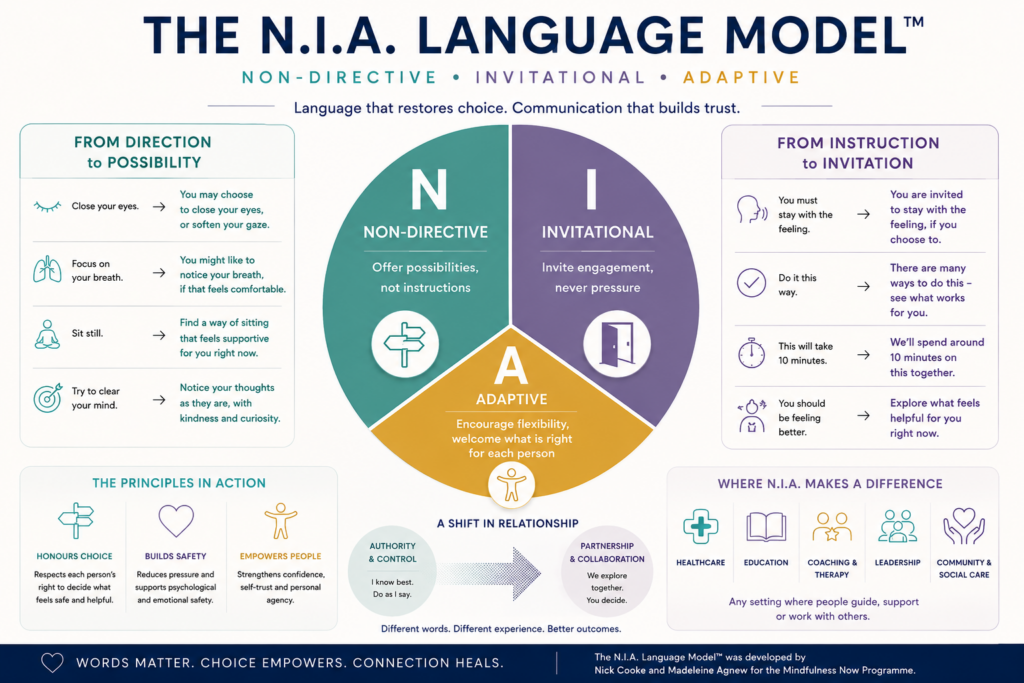
At its core, the N.I.A. Language Model restores agency to the learner.
It moves mindfulness away from prescription and towards participation.
The N.I.A. Language Model™
Developed by Nick Cooke and Madeleine Agnew, the N.I.A. Language Model™ was created to support a more accessible, trauma-sensitive approach to mindfulness communication.
N.I.A. stands for:
Non-Directive
Rather than telling participants what they should experience or how they must engage, teachers offer possibilities and options.
Invitational
Mindfulness is offered through invitations rather than commands, encouraging curiosity, exploration, and personal choice.
Adaptive
Teaching is responsive to individual needs, recognising that different learners may engage with mindfulness in different ways.
Together these principles help create environments that support autonomy, psychological safety, and genuine choice.
The Three Cs of Neurodiversity-Informed Mindfulness Language
As awareness of neurodiversity has grown, another important question has emerged:
How do we ensure that mindfulness language is not only choice-based, but also easy to understand?
This question led to the development of the Three Cs of Neurodiversity-Informed Mindfulness Language™.
The Three Cs provide a simple but powerful framework for accessible communication.
Clear
Use language that is straightforward, understandable, and easy to follow.
Concrete
Use language that is specific, literal, and observable wherever possible.
Concise
Use only the words that are needed, reducing unnecessary cognitive load and complexity.

These principles are particularly important for many neurodivergent learners, including some autistic individuals and those with different information-processing styles.
However, the benefits extend far beyond neurodiversity.
Most people find clear, concrete, and concise communication easier to engage with.
Why the N.I.A. Model and the Three Cs Work Together
The N.I.A. Language Model and the Three Cs address two different but equally important aspects of communication.
The N.I.A. principles help us consider:
How we offer mindfulness practice.
The Three Cs help us consider:
How we communicate mindfulness practice.
One without the other is incomplete.
Choice without clarity can create confusion.
Clarity without choice can feel controlling.
When combined, these frameworks create a communication style that is:
- Trauma-sensitive
- Neurodiversity-informed
- Accessible
- Inclusive
- Flexible
- Person-centred
Accessibility Is No Longer an Optional Extra
Historically, accessibility has often been viewed as an adaptation made for a small number of participants.
The future of mindfulness teaching requires a different perspective.
Accessibility should not sit at the edges of teaching.
Accessibility should sit at its centre.
The N.I.A. Language Model and the Three Cs represent a shift away from asking learners to adapt to mindfulness.
Instead, mindfulness adapts to meet the needs of learners.
This is not about lowering standards.
It is about removing unnecessary barriers.
It is about recognising that diversity is not an exception to mindfulness teaching—it is the reality of mindfulness teaching.
A New Frontier for Mindfulness Teachers
As mindfulness teachers, we are continually learning.
The growing understanding of trauma-informed practice, neurodiversity, inclusion, and accessibility is reshaping the way mindfulness is taught around the world.
The N.I.A. Language Model™ and the Three Cs of Neurodiversity-Informed Mindfulness Language™ provide practical frameworks for responding to this evolution.
They help teachers communicate with greater sensitivity, clarity, flexibility, and accessibility.
Most importantly, they help ensure that mindfulness remains available to everyone.
Because mindfulness is not truly accessible until its language is accessible.
And when we combine choice with clarity, flexibility with understanding, and inclusion with belonging, we create something powerful:
Accessible mindfulness for all.

The N.I.A. Language Model™ and the Three Cs of Neurodiversity-Informed Mindfulness Language™ were developed by Nick Cooke and Madeleine Agnew through Mindfulness Now as part of an ongoing commitment to accessible, trauma-sensitive and neurodiversity-informed mindfulness teaching.
References & Further Information
Professional Standards and Best Practice
Mindfulness Teachers Association (MTA)
https://mindfulnessteachers.org.uk
The UK’s largest professional register of accredited mindfulness teachers, promoting ethical, evidence-based, and inclusive mindfulness teaching standards.
British Association of Mindfulness-Based Approaches (BAMBA)
https://bamba.org.uk
The UK’s professional body for mindfulness practitioners, teachers, and training organisations, promoting safe, ethical, and evidence-based mindfulness teaching.
BAMBA Professional Standards
https://bamba.org.uk/professional-standards/
A framework outlining recognised standards for mindfulness teachers, including training, personal practice, supervision, retreat participation, and continuing professional development.
BAMBA Good Practice Guidelines
https://bamba.org.uk/good-practice-guidelines/
Widely recognised guidance supporting safe, ethical, and inclusive mindfulness teaching and training.
Mindfulness Research and Teacher Development
Oxford Mindfulness Foundation
https://www.oxfordmindfulness.org
Research, training, and resources supporting evidence-based mindfulness approaches.
Centre for Mindfulness Research and Practice (Bangor University)
https://www.bangor.ac.uk/mindfulness
One of the leading centres for mindfulness research, training, and teacher development.
Mindfulness Network
https://www.mindfulness-network.org
Resources, supervision, mentoring, and continuing professional development opportunities for mindfulness teachers.
Neurodiversity and Inclusive Communication
National Autistic Society
https://www.autism.org.uk
Guidance on autism, communication styles, inclusion, and accessibility.
Neurodiversity Hub
https://www.neurodiversityhub.org
Resources supporting inclusive learning and communication practices across diverse neurotypes.
ADHD Foundation
https://www.adhdfoundation.org.uk
Information and resources supporting neurodiversity-informed approaches to learning and wellbeing.
Trauma-Informed Practice
Trauma Informed UK
https://www.tiuk.org
Training and resources on trauma-informed practice across health, education, and wellbeing settings.
Beacon House Trauma Team
https://beaconhouse.org.uk
Accessible resources exploring trauma, nervous system regulation, attachment, and psychological safety.
Centre for Trauma-Informed Mindfulness
https://traumainformedmindfulness.org
Resources and perspectives on integrating mindfulness with trauma-informed approaches.
Accessibility and Inclusion
Information and guidance on disability inclusion and accessibility.
Equality and Human Rights Commission
https://www.equalityhumanrights.com
Guidance on equality, accessibility, and inclusive practice.
International Mindfulness Standards
International Mindfulness Teachers Association (IMTA)
https://imta.org
An international organisation promoting standards, accreditation, and professional development for mindfulness teachers worldwide.
Learn More About Accessible Mindfulness Language
Mindfulness Now
https://mindfulnessnow.org.uk
Training, resources, and professional development in mindfulness teaching, including the N.I.A. Language Model™ and the Three Cs of Neurodiversity-Informed Mindfulness Language™.
Suggested Closing Statement
The N.I.A. Language Model™ and the Three Cs of Neurodiversity-Informed Mindfulness Language™ were developed by Nick Cooke and Madeleine Agnew through Mindfulness Now as part of an ongoing commitment to accessible, trauma-sensitive, and neurodiversity-informed mindfulness teaching. These frameworks continue to evolve alongside emerging understanding of inclusion, communication, and best practice within the mindfulness profession.