


The Iceberg Model in Mindfulness Teaching: Why What Lies Beneath the Surface Matters

The Iceberg Model and Mindfulness Teaching

The Hidden Foundations of Transformative Learning

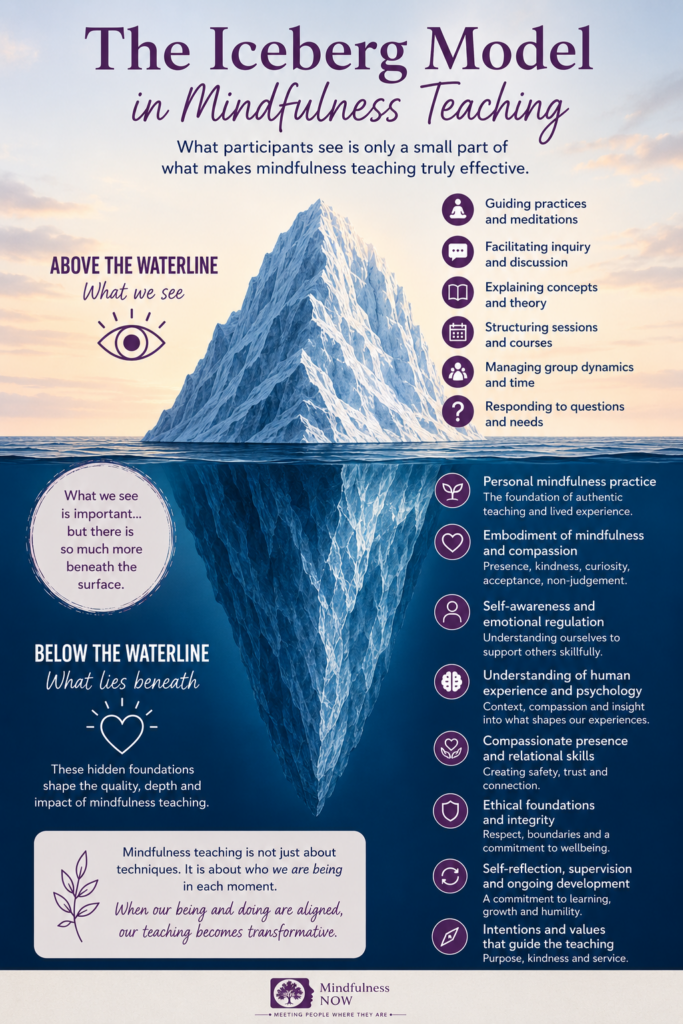
When people attend a mindfulness course, they naturally focus on what they can see. They experience guided meditations, group discussions, practical exercises, and opportunities for reflection. These visible elements are important, but they represent only a small part of what makes mindfulness teaching truly effective.

The Iceberg Model offers a helpful way of understanding this.

Like an iceberg, only a small portion of mindfulness teaching is visible above the surface. Beneath the waterline lies a much larger foundation that supports everything a teacher does. It is this hidden foundation that often determines the depth and quality of participants’ learning experiences.

What We See Above the Waterline

The visible aspects of mindfulness teaching include:

  • Guiding mindfulness and compassion practices
  • Facilitating inquiry and discussion
  • Explaining key concepts and theories
  • Creating a structured learning experience
  • Supporting participants through exercises and reflections
  • Managing group dynamics and learning needs

These skills are essential. They help participants engage with mindfulness in practical and meaningful ways.

However, mindfulness teaching is far more than the delivery of techniques. A meditation script alone does not create transformation. The quality of the teacher’s presence and embodiment plays an equally important role.

The Hidden Foundations Below the Surface

At Mindfulness Now, we recognise that effective teaching emerges from qualities that may not always be visible but are deeply felt by participants.

Personal Practice

A mindfulness teacher’s personal practice forms the bedrock of their teaching.

Through regular mindfulness and compassion practice, teachers develop a deeper understanding of their own thoughts, emotions, habits, and patterns of reactivity. This lived experience enables them to teach with authenticity rather than simply sharing information from books or training manuals.

Participants often recognise when a teacher is speaking from experience. There is a sense of genuineness that cannot be manufactured.
 

Embodiment

Embodiment is one of the most important aspects of mindfulness teaching.

Rather than simply explaining mindfulness, the teacher demonstrates it through their way of being. Embodiment may be reflected in:

  • Present-moment awareness
  • Kindness and compassion
  • Patience
  • Curiosity
  • Acceptance
  • Emotional balance
  • Authenticity

Participants learn not only from what the teacher says but also from how the teacher relates to themselves, the group, and whatever arises in the moment.

In many ways, the teacher becomes a living expression of the practice.


Compassionate Presence

Mindfulness Now places particular emphasis on the integration of mindfulness and compassion.

Compassionate presence allows teachers to meet participants with warmth, understanding, and acceptance. This creates the psychological safety needed for meaningful exploration and growth.

When people feel seen, heard, and accepted, they are often more willing to engage honestly with their experience.


Self-Reflection and Ongoing Development

Mindfulness teaching is not a destination but an ongoing journey.

Effective teachers continue to reflect on their practice, seek supervision, engage in continuing professional development, and remain open to learning from their own experience.

The willingness to remain a learner is one of the qualities that strengthens teaching over time.


Compassionate Inquiry: Exploring Beneath the Surface

The Iceberg Model also connects beautifully with the process of inquiry.

Within Mindfulness Now training, inquiry is not simply a discussion about meditation experiences. It is a compassionate exploration that helps participants become curious about what lies beneath their immediate thoughts, reactions, and behaviours.

Just as much of an iceberg remains hidden below the waterline, much of our inner experience operates beneath conscious awareness.

Through mindful inquiry, participants begin to notice:

  • Habitual thinking patterns
  • Emotional responses
  • Automatic reactions
  • Underlying beliefs
  • Unmet needs
  • Self-critical tendencies

By bringing these experiences into awareness with kindness and curiosity, new possibilities for understanding and change can emerge.


The Relationship Between Being and Doing

The Iceberg Model reminds us of a central principle within mindfulness teaching: the balance between being and doing.

Many educational approaches focus primarily on what a teacher does. Mindfulness teaching values skillful action, but it also recognises the importance of how a teacher is being.

Participants often remember less about the specific words that were spoken and more about how they felt in the teacher’s presence.

When mindfulness is embodied, teaching becomes more than instruction. It becomes a relational experience that invites participants to discover their own capacity for awareness, compassion, and wellbeing.

A Model for Teachers and Students Alike

The Iceberg Model is not only relevant for mindfulness teachers. It also offers a powerful framework for understanding our own personal growth.

We often focus on visible behaviours while overlooking the deeper patterns, beliefs, emotions, and attitudes that shape our lives. Mindfulness practice invites us to gently explore what lies beneath the surface.

As awareness develops, we begin to understand ourselves more fully and respond to life with greater wisdom and compassion.

At Mindfulness Now, we believe that transformative teaching grows from transformative practice. The most powerful aspects of mindfulness teaching are often invisible, yet they are felt in every interaction, every moment of presence, and every act of compassionate awareness.

Like the hidden mass of an iceberg, these deeper qualities provide the foundation upon which meaningful learning and lasting change can emerge.

Further Reading

Foundational Mindfulness Teaching

Crane, R. (2017). Mindfulness-Based Cognitive Therapy
A comprehensive exploration of mindfulness teaching, embodiment, and the development of mindfulness teachers.
https://www.routledge.com/Mindfulness-Based-Cognitive-Therapy/Crane/p/book/9781138647440

Crane, R., Soulsby, J., Kuyken, W., Williams, J.M.G., & Eames, C. (2013). The Bangor, Exeter & Oxford Mindfulness-Based Interventions Teaching Assessment Criteria (MBI:TAC)
A key framework highlighting the importance of embodiment in mindfulness teaching.
https://mbitac.bangor.ac.uk


Embodiment in Mindfulness Teaching

McCown, D., Reibel, D., & Micozzi, M. (2010). Teaching Mindfulness
Explores the relational and embodied aspects of mindfulness teaching.
https://link.springer.com/book/10.1007/978-0-387-09484-7

Mindfulness-Based Interventions: Teaching and Learning Companion
Resources exploring mindfulness embodiment and teaching practice.
https://mindfulnessteachersuk.org.uk


Compassion and Inquiry

Karen Atkinson (2018). Compassionate Mindful Inquiry in Therapeutic Practice
An exploration of compassionate inquiry and what lies beneath the surface of human experience.
https://www.amazon.co.uk/Compassionate-Mindful-Inquiry-Therapeutic-Practice/dp/0367336765

Gilbert, P. (2010). Compassion Focused Therapy
Provides valuable insights into compassion, emotional regulation, and the cultivation of self-compassion.
https://www.compassionatemind.co.uk


Personal Practice and Embodiment

Kabat-Zinn, J. (2013). Full Catastrophe Living
A foundational text on mindfulness practice and the attitudes that underpin mindful living.
https://www.mindfulnesscds.com/products/full-catastrophe-living

Nhat Hanh, T. (2015). The Miracle of Mindfulness
A timeless introduction to living mindfulness through everyday experience.
https://plumvillage.org/about/thich-nhat-hanh


Mindfulness Now

Mindfulness Now Teacher Training
Explore how mindfulness, compassion, embodiment, and inquiry are integrated within the Mindfulness Now approach.
https://mindfulnessnow.org.uk


Recommended Reflection

As you consider the Iceberg Model, reflect on this question:

What aspects of my teaching, leadership, or personal practice are visible above the surface, and what deeper qualities beneath the surface are supporting them?

Often, the most transformative aspects of mindfulness teaching are not what participants see, but what they experience through the teacher’s presence, compassion, and authenticity.


Learn Mindfulness: Avoid the Common Pitfalls and Discover What Everyone Is Talking About

Learn Mindfulness

Avoid the Common Pitfalls and Discover What Everyone Is Talking About

Perhaps you’ve heard friends, colleagues, healthcare professionals, or even celebrities talking about mindfulness. Maybe you’ve downloaded a mindfulness app, tried a couple of guided meditations, and wondered what all the fuss was about.

If that’s you, you’re certainly not alone.

Many people first encounter mindfulness through an app. They listen to a meditation or two, sit quietly for a few minutes, and then quickly decide that mindfulness simply isn’t for them. Their mind keeps wandering, they don’t experience any immediate benefits, and if they’re honest, they find the whole thing a bit boring.

The problem isn’t that mindfulness doesn’t work.

The problem is that many of us start with unrealistic expectations.

“My Mind Won’t Stop Thinking”

One of the most common reasons people give up on mindfulness is because they believe they’re doing it wrong.

They sit down, close their eyes, and within seconds their mind is busy thinking about work, family, shopping lists, emails, dinner, or what they should be doing instead of meditating.

So they conclude: “I can’t do mindfulness.”

In reality, noticing that your mind has wandered is mindfulness.

The aim isn’t to stop thinking or empty your mind. The practice is simply noticing where your attention has gone and gently bringing it back. Again and again.

Even experienced mindfulness practitioners find their minds wandering. The difference is that they’ve learned that this isn’t a problem—it’s part of the practice.

Looking for Instant Results

We live in a world that encourages quick fixes. We can stream a film instantly, order products for next-day delivery, and access information within seconds.

Mindfulness doesn’t work like that.

Many people try mindfulness once or twice and expect to feel dramatically different. When they don’t, they assume it isn’t effective.

But mindfulness is much more like learning a musical instrument than downloading a new app.

Nobody expects to pick up a guitar for the first time and play beautifully after two lessons. We understand that developing a new skill takes time, patience, guidance, and practice.

Mindfulness is no different.

The benefits emerge gradually as we learn to relate differently to our thoughts, emotions, and experiences.


Why Guidance Matters

Another common misconception is that mindfulness is something you should be able to teach yourself entirely through books, podcasts, or apps. While these can be useful starting points, many people find that having support from a trained mindfulness teacher makes a significant difference.

After all, when we want help with our physical health, we often seek support from a trained professional. When we want to learn a new skill, we usually look for someone with experience to guide us.

Mindfulness is no different.

A trained mindfulness teacher can help you understand what you’re experiencing, answer questions, and reassure you when challenges arise. They can help you avoid common misunderstandings and provide practices that are appropriate for your needs and experience. This support can make the difference between giving up and developing a sustainable mindfulness practice.

Finding the Right Kind of Support

For some people, attending an eight-week mindfulness programme is an ideal way to learn. These courses provide structured teaching, regular practice, and the opportunity to develop mindfulness skills over time.

However, an eight-week course isn’t the right fit for everyone.

Many mindfulness teachers also offer informal support groups, drop-in sessions, and online communities where people can continue learning and practising together.

These groups can be a wonderful way to receive encouragement from both a trained teacher and fellow participants.

Importantly, mindfulness groups are not group therapy.

You are never expected to discuss personal issues or share anything you don’t want to share. The focus is simply on learning mindfulness and exploring how to bring it into everyday life.

Many people find it reassuring to discover that others experience similar challenges and questions as they develop their practice.

The Science of Practice

You may have heard the term neuroplasticity.

This refers to the brain’s remarkable ability to change and adapt throughout our lives. Our brains are constantly being shaped by what we repeatedly do, think, and practise.

The more we practise mindfulness, the stronger the neural pathways associated with mindful awareness can become.

In simple terms, mindfulness often becomes easier with practice.

Over time, many people find they are better able to recognise unhelpful thought patterns, respond rather than react to difficult situations, and appreciate the richness of everyday experiences that might otherwise pass unnoticed.

Like any worthwhile skill, mindfulness develops gradually.

The more we practise, the more accessible it becomes.

Mindfulness Is About Living Your Life

Perhaps the most important thing to understand is that mindfulness isn’t about becoming perfectly calm, never feeling stressed, or achieving some special state of mind.

It’s about learning how to be more present for your life as it unfolds.

It’s about noticing the moments that might otherwise be missed.

It’s about developing a different relationship with thoughts and emotions.

And it’s about discovering that even ordinary moments can become richer, more meaningful, and more fully lived.

Taking the Next Step

If you’ve tried mindfulness before and concluded that it wasn’t for you, it may be worth reconsidering whether you simply needed more time, support, or guidance.

Learning mindfulness is a journey rather than a quick fix.

If you’d like support from a qualified mindfulness teacher, the Mindfulness Teachers Association maintains a register of trained mindfulness professionals across the UK. Exploring the register can be an excellent way to find a teacher, course, or support group that feels right for you.

You don’t have to figure mindfulness out on your own.

Like any valuable skill, mindfulness is something that grows through practice, patience, and the support of those who have walked the path before us.

You can search the register here:

Mindfulness Teachers Association Register
Find a Mindfulness Teacher

Further reading and resources

If you’d like to learn more about mindfulness and finding qualified support, the following resources may be helpful:

  • Mindfulness Teachers Association (MTA) – Professional register of accredited mindfulness teachers and information about professional standards.
    Visit the MTA Website
  • British Association of Mindfulness-Based Approaches (BAMBA) – Information about good practice guidelines and quality standards in mindfulness teaching.
  • Breathworks – Mindfulness resources and courses focusing on stress, wellbeing, pain, and long-term health conditions.
  • Oxford Mindfulness Foundation – Research-informed mindfulness programmes and resources.
  • NHS Every Mind Matters – Practical information on mindfulness and mental wellbeing.

You Are Not Your Thoughts: A Mindfulness Perspective on Inner Peace

The Water Beneath the Waves: Finding Peace Beyond Our Thoughts

“The water itself is always pure. Whether you put poison or medicine into it, the nature of the water does not fundamentally change.”
Matthieu Ricard

In our daily lives, it’s easy to become completely identified with what we are feeling. When anxiety rises, we think I am anxious. When anger appears, we believe I am angry. During periods of sadness or self-doubt, we can even begin to think there is something fundamentally wrong with us.

But what if these emotional states are not who we truly are?

Buddhist monk and meditation teacher Matthieu Ricard offers a powerful metaphor for understanding the nature of the mind. He compares awareness to water itself — naturally clear, open, and peaceful. Thoughts, emotions, and reactions are like substances temporarily mixed into that water. Some are nourishing, like medicine. Others are painful, like poison. Yet beneath it all, the essential nature of the water remains unchanged.

This simple image offers a profound shift in perspective — and one that lies at the heart of mindfulness practice.

The Mind Beneath the Noise

Most of us spend our lives reacting to the ever-changing weather of the mind. Thoughts race, emotions surge, worries pull us into the future, regrets drag us into the past. We often assume that because we feel something intensely, it must define who we are.

Mindfulness invites us to pause and look more closely.

When we sit quietly and observe the mind, we begin to notice something remarkable: thoughts and emotions are constantly changing. Anger comes and goes. Fear rises and falls. Joy appears and fades. Even our strongest moods are temporary visitors.

Yet there is something within us that notices all of this.

That noticing awareness — calm, alert, and present — is like the water Ricard describes. It is the stable background beneath the movement of thoughts and emotions. While the surface may become stormy, the deeper water remains undisturbed.

We Are Not Our Thoughts

One of the most liberating insights in mindfulness is recognising that thoughts are not facts, and emotions are not identity.

There is a subtle but powerful difference between saying:

  • I am angry
    and
  • Anger is present right now.

The first statement fuses our identity with the emotion. The second creates space. It allows us to observe the feeling without becoming consumed by it.

This doesn’t mean suppressing emotions or pretending difficult experiences don’t exist. Mindfulness is not about denying pain. It is about relating to it differently.

When we stop clinging to our thoughts and feelings as permanent truths about ourselves, we begin to experience greater freedom. We can respond rather than react. We can hold our emotions with compassion instead of fear.

The Practice of Awareness

Mindfulness helps us return to the “water” — the deeper awareness beneath the mind’s activity.

Through practices such as mindful breathing, body scans, or compassionate awareness, we learn to observe our internal experience with openness and curiosity. Over time, this strengthens our ability to remain grounded even during difficult moments.

We begin to realise:

  • Thoughts are events in the mind, not commands.
  • Emotions are waves, not permanent states.
  • Difficult experiences do not define our worth.

This understanding can be deeply healing, especially in times of stress, anxiety, grief, or overwhelm.

Rather than being swept away by every mental storm, we learn to rest in a steadier place within ourselves.

A More Compassionate Relationship with Ourselves

Many people carry a harsh inner critic — a voice that tells them they are failing, broken, or not enough. When we identify completely with these thoughts, suffering deepens.

Mindfulness offers another way.

If the mind is like water, then painful thoughts are simply passing conditions moving through awareness. They are not the essence of who we are.

This recognition naturally cultivates self-compassion. We stop treating ourselves as the problem and begin meeting our experience with kindness and patience.

And from this place, healing becomes possible.

Returning to What Is Already Here

The peace we seek is not something we must create from scratch. According to mindfulness teachings, it is already present beneath the noise of the mind.

Like clear water beneath muddy currents, our natural awareness remains intact even in difficult times.

The invitation of mindfulness is simply to remember this.

To pause.

To breathe.

To notice the thoughts and feelings moving through us without becoming lost in them.

And to reconnect, again and again, with the quiet, steady presence that has been there all along.


Further Reading & References

  • Matthieu Ricard — Official Website
    Insights, articles, and teachings on meditation, compassion, and altruism.
    Visit Website
  • Why Should I Meditate? — Matthieu Ricard, Lion’s Roar
    A thoughtful introduction to Buddhist meditation and awareness practice.
    Read Article
  • Mind & Life Institute — Matthieu Ricard Podcast
    Discussion on compassion, emotional wellbeing, and contemplative science.
    Listen to Podcast
  • Greater Good Magazine — Matthieu Ricard Profile
    Articles and reflections connecting mindfulness, compassion, and happiness research.
    Explore Resource
  • NHS: Mindfulness
    An accessible overview of mindfulness and its mental health benefits.
    Read NHS Guide
  • Study Buddhism — Interview with Matthieu Ricard
    Reflections on mindfulness, awareness, and meditation in modern life.
    Read Interview

This article was inspired by the teachings and writings of Buddhist monk Matthieu Ricard on awareness, compassion, and the nature of mind.

Neurodiversity-Informed Mindfulness Teacher Training

Neurodiversity-Informed Mindfulness Teacher Training

Mindful Inclusion: Supporting Neurodivergent Participants

As mindfulness continues to grow in reach and relevance, so too must our commitment to accessibility and inclusion. As mindfulness teachers, we are increasingly working with people who experience the world in diverse ways—and our teaching needs to reflect that.

It’s estimated that around 15–20% of the population is neurodivergent (Doyle, 2020). This means that in almost every group we teach, there will likely be participants whose brains process, feel, and respond differently from what is considered “neurotypical.”

Neurodivergent is a term that describes natural variations in how people think, learn, process information, experience emotions, and interact with the world. It includes experiences such as autism, ADHD, dyslexia, dyspraxia, Tourette syndrome, and sensory processing differences.

Rethinking Mindfulness Teaching

This training is an invitation to gently rethink what mindfulness teaching can be, who it is for, and how it is offered.

Becoming a neurodiversity-informed mindfulness teacher isn’t about learning a new toolkit to apply to “different” people. Instead, it’s about widening our understanding of human experience—and allowing mindfulness to meet people where they actually are, rather than where we expect them to be.

Neurodiversity reminds us that there is no single “correct” way for a brain or nervous system to function. These differences are not deficits to be fixed, but natural and valuable variations in human experience.

From this perspective, mindfulness becomes something that must be flexible, adaptive, and inclusive.

Why Inclusion Matters in Mindfulness Practice

Many traditional mindfulness practices have developed around neurotypical norms—such as stillness, silence, sustained attention, and inward focus.

While these approaches can be supportive for some, they can feel:

  • uncomfortable
  • inaccessible
  • or even overwhelming

for others.

Neurodivergent individuals are also more likely to have experienced:

  • trauma
  • marginalisation
  • misunderstanding
  • pressure to mask who they are

For some participants, turning attention inward can feel intense or unsafe rather than calming. This training acknowledges these realities with honesty and compassion.

What You’ll Explore in This Training

During this course, we explore how different forms of neurodivergence—such as autism, ADHD, dyslexia, dyspraxia, and sensory processing differences—can shape how people engage with mindfulness.

Through discussion, reflection, and experiential practice, you will:

  • deepen your understanding of neurodivergent experiences

  • explore inclusive and flexible teaching approaches

  • learn practical adaptations to support accessibility

  • practice applying these approaches with fellow participants

This is not just about techniques—it’s about a shift in mindset, rooted in curiosity, compassion, and respect.

A Compassionate and Flexible Approach

At its heart, this training is grounded in:

  • compassion
  • flexibility
  • respect for individual differences

It offers both practical tools and a broader perspective, supporting you to create mindfulness spaces where more people feel safe, seen, and included.

Meet the Trainers

Madeleine Agnew and Sue Hutton bring a powerful combination of lived and professional experience to this work. Both are deeply committed to making mindfulness more inclusive and responsive to neurodivergent ways of being.

Madeleine has over eight years of experience training mindfulness teachers. She has developed programmes in trauma-informed mindfulness, work with children and teens, and compassion-focused wellbeing. Her work supports teachers to offer mindfulness safely and skilfully in complex and sensitive contexts.

Sue teaches mindfulness in Toronto, Canada, with a strong focus on compassionate inclusion. For over a decade, she has worked with a research team at the CAMH Azrieli Adult Neurodevelopment Centre, adapting mindfulness practices for autistic adults, adults with learning disabilities, and their caregivers.

Together, Madeleine and Sue have developed this training to support mindfulness teachers across a wide range of settings—offering practical insights, meaningful adaptations, and inclusive approaches that help mindfulness truly meet the needs of all participants.

Moving Toward Truly Inclusive Mindfulness

Mindfulness has the potential to be a deeply supportive practice—but only if it is accessible.

This training is part of a wider movement toward mindful inclusion—where difference is not something to work around, but something we actively welcome and learn from.

Because mindfulness isn’t about fitting people into a practice.
It’s about shaping the practice so it can meet people—just as they are.

“Developing as a neurodiversity-informed mindfulness teacher is an ongoing journey. These resources offer a starting point—supporting us to listen more deeply, adapt more thoughtfully, and create spaces where everyone can access mindfulness in ways that feel safe and meaningful.”

Further Resources (UK)

We encourage ongoing learning and signpost the following trusted organisations and professional bodies:

Mindfulness teaching standards & professional bodies

  • Mindfulness Teachers Association (MTA) – the UK’s largest professional body and register of accredited mindfulness teachers
    https://mindfulnessteachers.org.uk

  • British Association of Mindfulness-Based Approaches (BAMBA) – good practice guidance and standards for mindfulness-based teaching in the UK
    https://bamba.org.uk

Accessible & Inclusive Mindfulness Teacher Training | LGBTQ+ Friendly | Mindfulness Now UK

Accessible & Inclusive Mindfulness Teacher Training
| LGBTQ+ Friendly | Mindfulness Now UK

Accessible and Inclusive Mindfulness Teaching

At Mindfulness Now UK, we are committed to delivering accessible, inclusive and LGBTQ+ friendly mindfulness teacher training and courses.

We believe mindfulness training should be open to everyone — regardless of sexual orientation, gender identity, background, ability, age, culture, or lived experience. Inclusion is not an add-on to our training; it is central to how we teach.

Whether you are joining a mindfulness course for personal development or enrolling in our Mindfulness Teacher Training programme, you can expect a respectful, affirming and supportive learning environment.

LGBTQ+ Friendly Mindfulness Training

We proudly welcome people who identify as: Lesbian, Gay, Bisexual, Transgender, Non-binary, Queer, Questioning, Intersex, Asexual, and across the full spectrum of gender and sexuality.

Our training spaces are:

  • Affirming of all gender identities and expressions
  • Respectful of chosen names and pronouns
  • Free from heteronormative assumptions
  • Committed to zero tolerance of discrimination

We recognise that LGBTQ+ individuals may experience minority stress and social marginalisation. Our approach to mindfulness teaching is sensitive, compassionate and grounded in real-world awareness.

Trauma-Sensitive & Accessible Mindfulness Teaching

Mindfulness Now was developed with accessibility and flexibility at its heart. Our approach to mindfulness teacher training includes:

  • Trauma-sensitive teaching principles
  • Choice-based practice invitations
  • Respect for personal boundaries
  • Adaptations for physical accessibility
  • Inclusive language throughout

We understand that people arrive at mindfulness from diverse life experiences. Our training supports autonomy, safety and empowerment.

Inclusive Mindfulness Teacher Training in the UK & Online

We offer:

  • Accredited Mindfulness Teacher Training
  • Continuing Professional Development (CPD)
  • Online and in-person options
  • Flexible pathways to qualification

If you are searching for:

  • “Inclusive mindfulness teacher training UK”
  • “LGBTQ+ friendly mindfulness course”
  • “Accessible mindfulness training”
  • “Trauma-informed mindfulness teaching”— you are in the right place.

Our Ongoing Commitment to Diversity & Inclusion

Inclusion is an evolving practice. We are committed to:

  • Continuing professional development in equality, diversity and inclusion
  • Reflecting diverse experiences in course materials
  • Listening to feedback from our community
  • Reviewing and improving policies regularly

We aim to model the mindful values we teach: awareness, compassion, and non-judgement.

You Belong Here

Mindfulness is not reserved for a particular identity, background, or belief system.

If you are looking for mindfulness teacher training that values accessibility, inclusivity and LGBTQ+ affirmation, we warmly welcome you.

If you would like to discuss access needs before enrolling, please contact:

info@mindfulnessnowdevon.org

Further Resources (UK)

We encourage ongoing learning and signpost the following trusted organisations and professional bodies:

Mindfulness teaching standards & professional bodies

  • Mindfulness Teachers Association (MTA) – the UK’s largest professional body and register of accredited mindfulness teachers
    https://mindfulnessteachers.org.uk

  • British Association of Mindfulness-Based Approaches (BAMBA) – good practice guidance and standards for mindfulness-based teaching in the UK
    https://bamba.org.uk

LGBTQ+ inclusion & support (UK)

Equality & rights (UK)