



Living Well with Parkinson’s Disease: My Journey with Mindfulness
By Nick Cooke
There are moments in life that divide everything into a “before” and an “after.”
Receiving a diagnosis of Parkinson’s disease was one of those moments for me.
Although I had already lived through other serious health challenges, including diabetes and cancer, hearing the words “you have Parkinson’s disease” brought a different kind of fear. It was not simply fear of illness itself, but fear of change, uncertainty, loss, and what the future might hold.
Like many people living with long-term illness, I experienced trauma following my diagnoses. Trauma is not always one dramatic event. Sometimes it is the slow and painful process of watching your life change in ways you never expected. Sometimes it is grieving the body you once had. Sometimes it is learning to live with uncertainty every single day.
For many years, mindfulness and meditation had already been a central part of my life. I had practised meditation for decades and worked as a psychotherapist helping others better understand the mind and their own human experience. But when illness entered my life more deeply, I realised something important:
The mindfulness I now needed was very different from the mindfulness I had previously known.
When Practice Changes
I remember the first time I realised I could no longer comfortably sit still in a meditation group because of my Parkinson’s tremors.
It may sound like a small thing, but for me it carried enormous emotional weight.
Meditation had always looked a certain way in my mind. Quiet. Still. Calm. Controlled. Suddenly my body no longer allowed that experience. I remember feeling embarrassed. Ashamed even. I worried I was distracting others. I felt grief for the loss of something that had once come naturally to me.
Over time, however, I began to understand something deeply important:
Mindfulness is not about forcing ourselves to fit a particular image of practice.
Mindfulness is about meeting ourselves exactly where we are.
That understanding changed everything for me.
Learning to Meet Suffering with Compassion
Living with Parkinson’s disease has taught me many things. It has taught me humility. It has taught me patience. It has taught me how fragile life can feel at times.
But perhaps most importantly, it has taught me compassion.
Not the kind of compassion that sounds nice in theory, but the kind born through struggle, loss, vulnerability, and acceptance.
There were times when my mindfulness practice became the very thing that held me together. Not because it made my illness disappear, but because it helped me stay present with what was happening without completely collapsing beneath it.
Mindfulness became a lifeline.
There were days when sitting meditation was impossible. So I adapted. There were times when stillness was not available to me, so I learned mindfulness through movement, through breathing, through listening, through simply being kind to myself in difficult moments.
I came to realise that mindfulness practice looks different for every person.
For some people it may be sitting quietly for forty minutes. For others it may simply be noticing the feeling of their feet on the floor whilst living with pain, anxiety, trauma, or illness. Both are valid. Both matter.
It must meet people where they are.
That phrase has become central to everything we teach.
The Birth of the Mindfulness Now Approach
Out of these experiences, the Mindfulness Now approach slowly emerged.
It was never created as a rigid programme or fixed method. In many ways, it grew organically through my own life experience — through illness, through healing, through listening to others, and through recognising that many people simply did not feel included in traditional mindfulness settings.
I began to see how many individuals were struggling silently. People living with trauma. Chronic illness. Anxiety. Disability. Grief. People who felt they were somehow “failing” at mindfulness because they could not sit still, concentrate, relax, or meditate in the “right” way.
But there is no one right way.
The Mindfulness Now approach was born from the belief that mindfulness must be adaptable, person-centred, trauma-informed, and compassionate.
Living with Parkinson’s Today
People sometimes ask me whether mindfulness cures Parkinson’s disease.
The answer is no.
I still live with Parkinson’s every day. I still experience difficult symptoms. There are still moments of frustration, exhaustion, sadness, and fear. Mindfulness has not removed my suffering completely.
But what it has changed is my relationship with suffering.
Mindfulness has helped me find moments of peace in the middle of uncertainty. It has helped me soften around fear rather than constantly fighting it. It has helped me reconnect with joy, gratitude, and meaning even during difficult times.
Perhaps most importantly, it has helped me accept my changing body with greater kindness.
That acceptance did not happen overnight. It continues to be a journey. But slowly, over many years, I have learned that healing does not always mean becoming free from illness. Sometimes healing means learning how to live fully and compassionately alongside what is here.
One thing I have also learned through illness is the importance of not taking myself too seriously. Mindfulness is often spoken about in very serious ways, but for me, gentle humour, lightness, and the ability to smile at the human condition have become deeply important parts of my practice. Even in difficult moments, humour can reconnect us with our inner resilience, warmth, and humanity. I have found that bringing gentleness, perspective, and even laughter into my approach to life has enormous power. It helps me reconnect with inner resources that can so easily become hidden beneath fear, struggle, or suffering.
Why Trauma-Informed Mindfulness Matters
One of the things illness taught me very clearly is that mindfulness must feel emotionally safe.
For many people, silence can feel frightening. Closing the eyes can feel unsafe. Sitting with bodily sensations can be overwhelming, particularly for those living with trauma or illness.
This is why trauma-informed mindfulness matters so deeply to me.
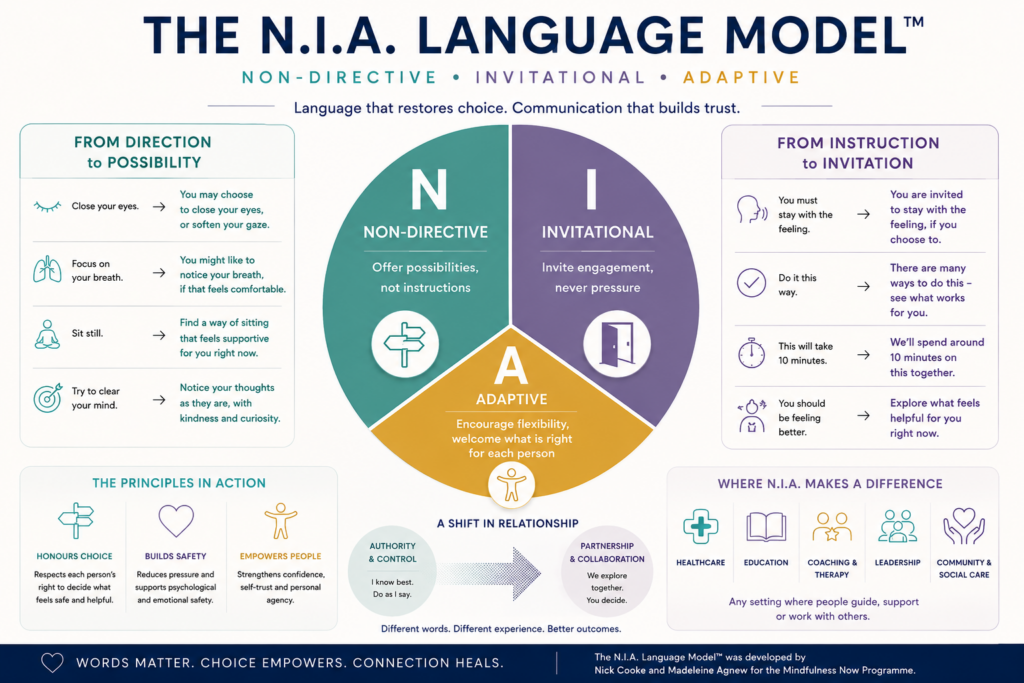
Within Mindfulness Now we encourage the use of what we call the NIA language model — Non-directive, Invitational, and Adaptive language.
This means we invite people rather than instruct them. We offer choice rather than pressure. We encourage people to listen to themselves and honour their own needs.

Because real mindfulness is not about pushing through discomfort at all costs.
It is about learning to listen deeply and compassionately to ourselves.
My Hope for the Future
When I first began teaching the Mindfulness Now programme in Birmingham around the year 2000, I could never have imagined it would eventually reach people around the world.
Today, alongside a passionate and compassionate team, we continue to train mindfulness teachers who share this vision of inclusive, adaptable, trauma-informed mindfulness.
My hope is simple:
That mindfulness becomes accessible to everyone.
Not just to those who are healthy, confident, calm, or able-bodied. But to everyone — including those living with illness, trauma, anxiety, grief, disability, or struggle.
Because mindfulness was there for me during some of the darkest periods of my life.
And I truly believe that within every human being there exists an incredible capacity for awareness, compassion, resilience, and wisdom — even in the midst of suffering.
Living with Parkinson’s disease has changed my life profoundly.
But it has also taught me how precious life is.
It has taught me to slow down. To appreciate small moments. To soften. To let go of perfection. To meet myself with kindness.
And perhaps that, in the end, is what mindfulness has always really been about.