The N.I.A Trauma Informed Teaching Model

A New Approach to Inclusive Mindfulness Teaching

Over the past two decades, mindfulness has become increasingly recognised as an effective approach for supporting wellbeing, stress reduction, emotional resilience, and mental health. Programmes such as Mindfulness-Based Stress Reduction (MBSR) and Mindfulness-Based Cognitive Therapy (MBCT) have established a strong evidence base and have helped millions of people around the world.

At Mindfulness Now, we deeply value and respect these pioneering approaches. In fact, our programme is built upon the same core mindfulness principles of awareness, compassion, present-moment attention, inquiry, and self-reflection.

So what makes Mindfulness Now different?

The answer lies not in changing mindfulness itself, but in making mindfulness more accessible, adaptable, and inclusive for the diverse range of people who may benefit from it.

Responding to Real-World Barriers

The development of Mindfulness Now emerged from a simple but important observation: many people who could benefit from mindfulness training were not engaging with traditional programmes.

Over many years of teaching and supporting participants, recurring barriers became evident. These included:

  • Work and family commitments
  • Caring responsibilities
  • Financial limitations
  • Geographical isolation
  • Physical health challenges
  • Anxiety about attending groups
  • Neurodiversity-related learning needs
  • Educational barriers
  • Cultural differences
  • The perception that mindfulness courses were overly academic or inaccessible

For some individuals, committing to a highly structured programme was simply not practical. Others found that traditional teaching styles did not always meet their personal learning preferences or circumstances.

These observations prompted an important question:

How can mindfulness training remain true to its evidence-based foundations while becoming more accessible to the people who need it most?

Mindfulness Now was developed as part of the answer.
A Flexible Framework Rather Than a Fixed Formula

One of the defining features of Mindfulness Now is its flexibility.

Whilst maintaining a clear structure and progression, the programme was intentionally designed as a framework rather than a rigid curriculum.

This allows qualified teachers to respond sensitively to the needs of participants whilst preserving the integrity of the mindfulness practices themselves.

As a result, Mindfulness Now can be successfully delivered in a wide variety of settings, including:

  • Community wellbeing groups
  • Healthcare environments
  • Educational settings
  • Workplace wellbeing programmes
  • One-to-one sessions
  • Online learning environments
  • Blended learning formats
  • Therapeutic and supportive services

This adaptability enables mindfulness to reach individuals who may otherwise struggle to engage with more standardised approaches.

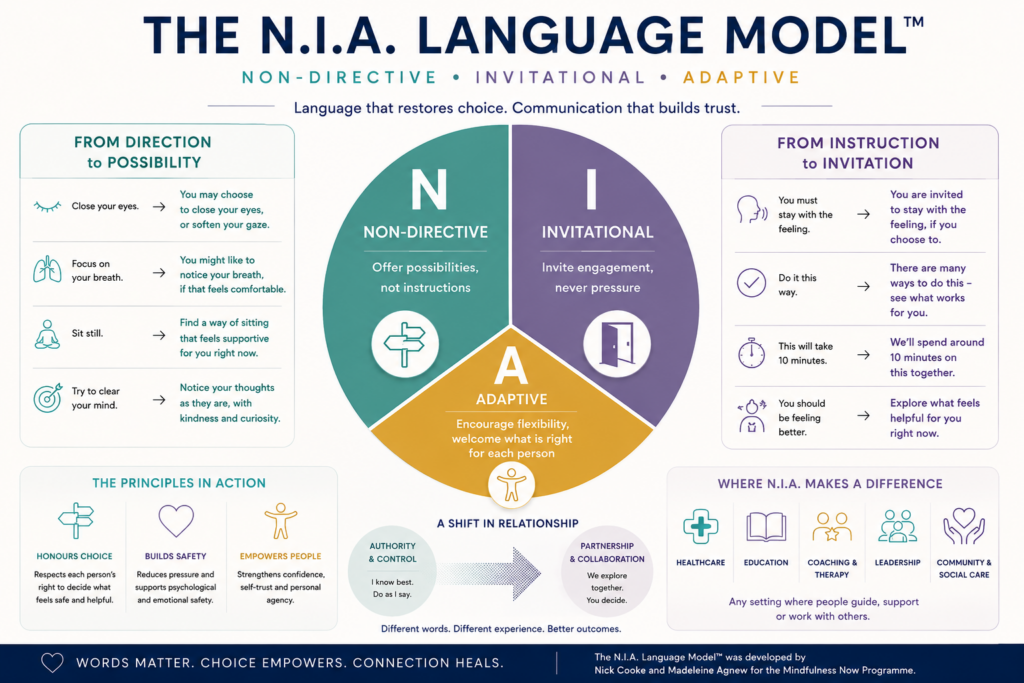
The NIA Language Model approach offers an alternative.

Instead of directing, teachers invite.

For example:

  • “If it feels comfortable, you might choose to close your eyes.”
  • “You may wish to bring some attention to the breath.”
  • “Perhaps you could explore what is present in your experience right now.”
  • “You might notice sensations in the body, or perhaps something else naturally draws your attention.”

This subtle shift changes the learning environment profoundly.

Participants remain empowered to make choices about how they engage, creating a sense of ownership, safety, and self-agency.

Introducing the N.I.A Trauma Informed Language Model

Perhaps the most distinctive innovation within Mindfulness Now is the development of the N.I.A Model.

N.I.A stands for:

Non-directive, Invitation and Adaptive Language

C0-developed by Nick Cooke and Madeleine Agnew for the Mindfulness Now Programme, the N.I.A Language Model provides a communication framework designed to enhance participant autonomy, psychological safety, and accessibility.

At its heart lies a simple but powerful principle:

People engage more effectively when they are invited rather than instructed.

Traditional teaching methods can sometimes unintentionally create pressure through directive language such as:

  • “Close your eyes.”
  • “Focus on your breath.”
  • “Relax your body.”
  • “You should notice…”

For some participants, these instructions feel perfectly comfortable. For others, they can create discomfort, resistance, anxiety, or even feelings of failure if their experience differs from what they believe is expected.

Why Language Matters

Language shapes experience.

Research across psychology, education, healthcare, and trauma-informed practice increasingly highlights the importance of autonomy-supportive communication.

When individuals feel they have choice, control, and permission to engage in ways that suit their needs, learning often becomes more effective and sustainable.

The NIA Model supports this by:

  • Reducing performance pressure
  • Encouraging curiosity over judgement
  • Supporting participant autonomy
  • Enhancing inclusivity
  • Creating psychologically safe learning environments
  • Supporting trauma-sensitive practice
  • Accommodating diverse learning styles
  • Improving accessibility for neurodivergent participants

Rather than prescribing a “correct” mindfulness experience, NIA encourages exploration and personal discovery.

Supporting Neurodiversity and Inclusion

One of the strengths of the NIA Model is its relevance for neurodiverse learners.

People with ADHD, autism, sensory processing differences, anxiety, or other forms of neurodiversity often engage with mindfulness in highly individual ways.

A rigid expectation that everyone should experience practices similarly can unintentionally exclude those whose experiences differ.

NIA recognises that there is no single right way to practise mindfulness.

Participants are encouraged to explore what works for them, adapt practices where appropriate, and develop self-awareness in a way that honours their unique needs and experiences.

This aligns closely with Mindfulness Now’s wider commitment to inclusivity and accessibility.

Learning Through Experience

Mindfulness Now has evolved through years of participant feedback, teacher reflection, supervision, and practical experience.

Again and again, participants highlighted the value of:

  • Feeling accepted rather than judged
  • Being given choices
  • Learning at their own pace
  • Receiving ongoing support
  • Having practices adapted to their circumstances
  • Feeling included regardless of background or experience

The programme continues to evolve in response to these insights whilst remaining grounded in the established evidence base of mindfulness practice.

Looking Forward

As mindfulness continues to grow worldwide, accessibility and inclusivity are becoming increasingly important conversations.

Mindfulness Now believes that evidence-based mindfulness should be available to everyone—not only those who can fit comfortably within traditional delivery models.

Through flexible programme design, adaptive teaching practices, and the innovative NIA communication framework, Mindfulness Now seeks to create learning environments where people feel welcomed, empowered, and supported.

Because mindfulness is not about fitting people into a programme.

It is about creating programmes that can meet people where they are.

And that may be one of the most mindful approaches of all.