

Living Well with Parkinson’s Disease: My Journey with Mindfulness by Nick Cooke

Living Well with Parkinson’s Disease: My Journey with Mindfulness

By Nick Cooke

There are moments in life that divide everything into a “before” and an “after.”

Receiving a diagnosis of Parkinson’s disease was one of those moments for me.

Although I had already lived through other serious health challenges, including diabetes and cancer, hearing the words “you have Parkinson’s disease” brought a different kind of fear. It was not simply fear of illness itself, but fear of change, uncertainty, loss, and what the future might hold.

Like many people living with long-term illness, I experienced trauma following my diagnoses. Trauma is not always one dramatic event. Sometimes it is the slow and painful process of watching your life change in ways you never expected. Sometimes it is grieving the body you once had. Sometimes it is learning to live with uncertainty every single day.

For many years, mindfulness and meditation had already been a central part of my life. I had practised meditation for decades and worked as a psychotherapist helping others better understand the mind and their own human experience. But when illness entered my life more deeply, I realised something important:

The mindfulness I now needed was very different from the mindfulness I had previously known.

When Practice Changes

I remember the first time I realised I could no longer comfortably sit still in a meditation group because of my Parkinson’s tremors.

It may sound like a small thing, but for me it carried enormous emotional weight.

Meditation had always looked a certain way in my mind. Quiet. Still. Calm. Controlled. Suddenly my body no longer allowed that experience. I remember feeling embarrassed. Ashamed even. I worried I was distracting others. I felt grief for the loss of something that had once come naturally to me.

Over time, however, I began to understand something deeply important:

Mindfulness is not about forcing ourselves to fit a particular image of practice.

Mindfulness is about meeting ourselves exactly where we are.

That understanding changed everything for me.

Learning to Meet Suffering with Compassion

Living with Parkinson’s disease has taught me many things. It has taught me humility. It has taught me patience. It has taught me how fragile life can feel at times.

But perhaps most importantly, it has taught me compassion.

Not the kind of compassion that sounds nice in theory, but the kind born through struggle, loss, vulnerability, and acceptance.

There were times when my mindfulness practice became the very thing that held me together. Not because it made my illness disappear, but because it helped me stay present with what was happening without completely collapsing beneath it.

Mindfulness became a lifeline.

There were days when sitting meditation was impossible. So I adapted. There were times when stillness was not available to me, so I learned mindfulness through movement, through breathing, through listening, through simply being kind to myself in difficult moments.

I came to realise that mindfulness practice looks different for every person.

For some people it may be sitting quietly for forty minutes. For others it may simply be noticing the feeling of their feet on the floor whilst living with pain, anxiety, trauma, or illness. Both are valid. Both matter.

It must meet people where they are.

That phrase has become central to everything we teach.

The Birth of the Mindfulness Now Approach

Out of these experiences, the Mindfulness Now approach slowly emerged.

It was never created as a rigid programme or fixed method. In many ways, it grew organically through my own life experience — through illness, through healing, through listening to others, and through recognising that many people simply did not feel included in traditional mindfulness settings.

I began to see how many individuals were struggling silently. People living with trauma. Chronic illness. Anxiety. Disability. Grief. People who felt they were somehow “failing” at mindfulness because they could not sit still, concentrate, relax, or meditate in the “right” way.

But there is no one right way.

The Mindfulness Now approach was born from the belief that mindfulness must be adaptable, person-centred, trauma-informed, and compassionate.

Living with Parkinson’s Today

People sometimes ask me whether mindfulness cures Parkinson’s disease.

The answer is no.

I still live with Parkinson’s every day. I still experience difficult symptoms. There are still moments of frustration, exhaustion, sadness, and fear. Mindfulness has not removed my suffering completely.

But what it has changed is my relationship with suffering.

Mindfulness has helped me find moments of peace in the middle of uncertainty. It has helped me soften around fear rather than constantly fighting it. It has helped me reconnect with joy, gratitude, and meaning even during difficult times.

Perhaps most importantly, it has helped me accept my changing body with greater kindness.

That acceptance did not happen overnight. It continues to be a journey. But slowly, over many years, I have learned that healing does not always mean becoming free from illness. Sometimes healing means learning how to live fully and compassionately alongside what is here.

One thing I have also learned through illness is the importance of not taking myself too seriously. Mindfulness is often spoken about in very serious ways, but for me, gentle humour, lightness, and the ability to smile at the human condition have become deeply important parts of my practice. Even in difficult moments, humour can reconnect us with our inner resilience, warmth, and humanity. I have found that bringing gentleness, perspective, and even laughter into my approach to life has enormous power. It helps me reconnect with inner resources that can so easily become hidden beneath fear, struggle, or suffering.

Why Trauma-Informed Mindfulness Matters

One of the things illness taught me very clearly is that mindfulness must feel emotionally safe.

For many people, silence can feel frightening. Closing the eyes can feel unsafe. Sitting with bodily sensations can be overwhelming, particularly for those living with trauma or illness.

This is why trauma-informed mindfulness matters so deeply to me.

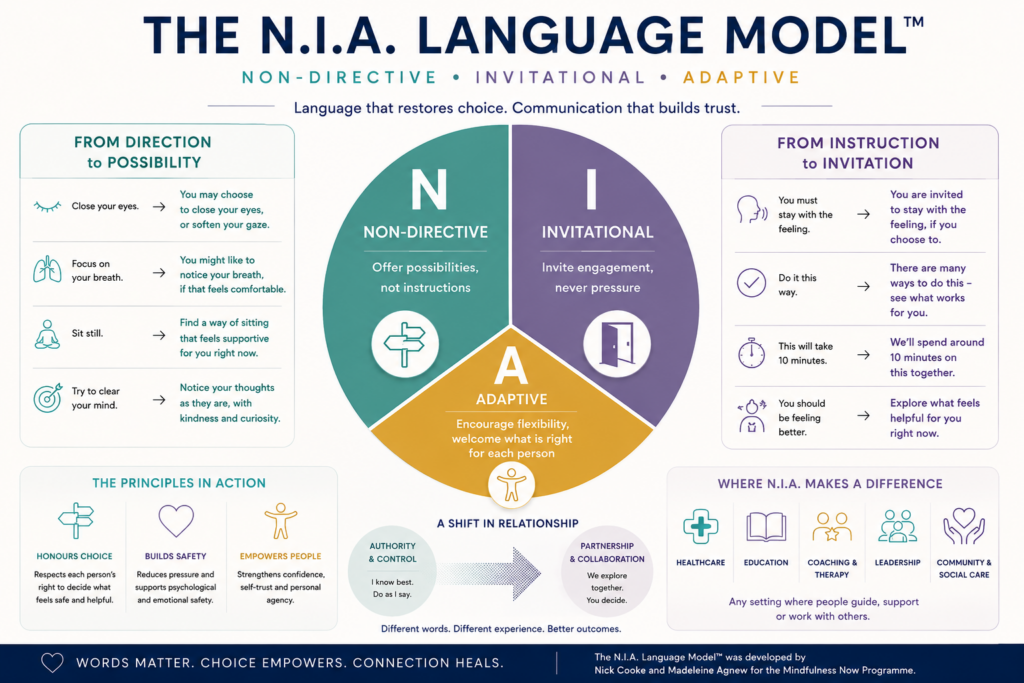
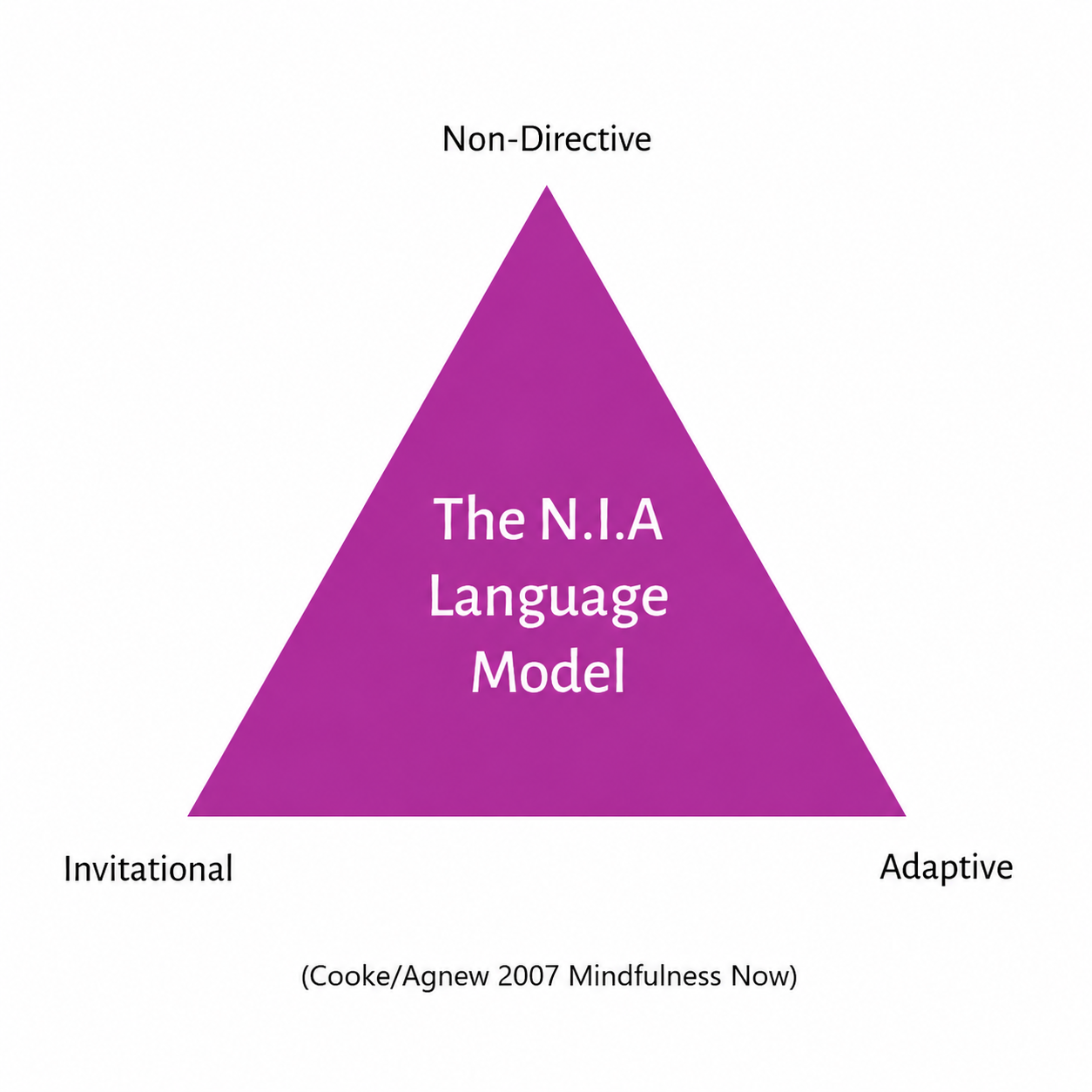
Within Mindfulness Now we encourage the use of what we call the NIA language model — Non-directive, Invitational, and Adaptive language.

This means we invite people rather than instruct them. We offer choice rather than pressure. We encourage people to listen to themselves and honour their own needs.

Because real mindfulness is not about pushing through discomfort at all costs.

It is about learning to listen deeply and compassionately to ourselves.

My Hope for the Future

When I first began teaching the Mindfulness Now programme in Birmingham around the year 2000, I could never have imagined it would eventually reach people around the world.

Today, alongside a passionate and compassionate team, we continue to train mindfulness teachers who share this vision of inclusive, adaptable, trauma-informed mindfulness.

My hope is simple:

That mindfulness becomes accessible to everyone.

Not just to those who are healthy, confident, calm, or able-bodied. But to everyone — including those living with illness, trauma, anxiety, grief, disability, or struggle.

Because mindfulness was there for me during some of the darkest periods of my life.

And I truly believe that within every human being there exists an incredible capacity for awareness, compassion, resilience, and wisdom — even in the midst of suffering.

Living with Parkinson’s disease has changed my life profoundly.

But it has also taught me how precious life is.

It has taught me to slow down. To appreciate small moments. To soften. To let go of perfection. To meet myself with kindness.

And perhaps that, in the end, is what mindfulness has always really been about.

About Nick Cooke Founder of the Mindfulness Now Programme

About Nick Cooke

Founder of the Mindfulness Now Programme

Nick Cooke is the founder and creator of the Mindfulness Now Programme and has over 40 years of personal mindfulness and meditation practice experience.

Although his professional life began in the fast-paced corporate world, from a young age Nick developed a deep passion for understanding the mind and helping others better understand their own inner experience. In his twenties, he trained as a psychotherapist and began working with clients, while continuing to pursue his lifelong commitment to meditation and mindfulness practice.

At that time, mindfulness was still largely outside mainstream healthcare and psychological services in the UK. It was not until the 1990s, when Mindfulness-Based Stress Reduction (MBSR) became more widely recognised, that Nick began to see the possibility of bringing mindfulness more directly into his therapeutic work with clients.

A Personal Journey Through Illness and Trauma

Around this same period, Nick himself became seriously unwell.

Over the last three decades, he has lived with several long-term and progressive health conditions, including diabetes, Parkinson’s disease, and cancer. Nick openly describes the profound trauma and emotional impact that followed these diagnoses, and how his mindfulness practice became not simply a professional interest, but a lifeline.

As his health challenges deepened, Nick realised he needed to relate to mindfulness in a very different way. Traditional approaches did not always reflect the realities of living with illness, trauma, pain, uncertainty, or a changing body.

Through his own lived experience, he began developing what he later called the Mindfulness Now Approach — an approach rooted in compassion, flexibility, acceptance, and meeting people where they are.

For Nick, mindfulness became a way not only to cope with suffering, but to live alongside it with greater kindness, resilience, meaning, and even joy.

Nick has also learned never to take himself too seriously! Bringing lightness, gentleness, and humour into both his mindfulness practice and his approach to life has been incredibly important to him and his teaching style. “Even during difficult times, humour can reconnect us with our humanity, resilience, and inner strength. Sometimes a smile, a moment of softness, or the ability to laugh at ourselves can be deeply healing.”

Nick believes mindfulness must be adaptable, trauma-sensitive, inclusive, and person-centred. Rather than expecting individuals to fit into a rigid model of practice, the practice itself must adapt to the needs, abilities, experiences, and realities of each person.

Mindfulness Looks Different for Everyone

One of the core understandings Nick developed through illness was that mindfulness practice does not look the same for everybody.

He has spoken openly about the experience of living with Parkinson’s disease and the moment he realised he could no longer comfortably sit still in meditation groups because of his tremors. He describes feelings of grief, loss, embarrassment, and shame during that time.

Over the years, however, his practice evolved into one of deeper acceptance and compassion toward himself and his changing body.

This lived experience became central to the philosophy behind Mindfulness Now.

The Creation of Mindfulness Now

The Mindfulness Now Programme was first taught at Nick Cooke’s clinic in Birmingham, UK, around the year 2000.

Since then, the approach has grown internationally and has supported people around the world in learning mindfulness in ways that feel accessible, safe, compassionate, and sustainable.

Today, Nick leads a successful mindfulness training school alongside a small and passionate team of colleagues who share his vision for a more inclusive and trauma-informed approach to mindfulness teaching.

A Vision for the Future

Nick’s hope for the future is simple but deeply heartfelt: to make mindfulness as accessible as possible to as many people as possible.

Mindfulness was there for him — and continues to support him — during some of the most difficult periods of his life. His wish is that others may also discover the strength, wisdom, compassion, and healing potential that can emerge through mindful awareness.

At the centre of the Mindfulness Now approach is the belief that everybody deserves access to mindfulness, regardless of their background, health, age, experience, or circumstances.

The programme continues to grow from this vision: creating safe, compassionate, trauma-informed spaces where people can reconnect with themselves and discover new ways of living with greater awareness, kindness, and resilience.

The Changing Face of Mindfulness: Towards Trauma-Informed, Inclusive, and Compassionate Practice

The Changing Face of Mindfulness

Towards Trauma-Informed, Inclusive, and Compassionate Practice

In recent years, the world of mindfulness has been undergoing a profound transformation.

Across mindfulness training, meditation teaching, and wellbeing programmes, there has been a growing recognition that mindfulness must evolve to meet the diverse realities of human experience. Conversations around trauma-informed practice, neurodiversity, accessibility, LGBTQIA+ inclusion, and cultural sensitivity are no longer happening at the margins — they are becoming central to the future of mindfulness itself.

This shift is not about abandoning mindfulness traditions. Rather, it is about deepening our understanding of what compassion, awareness, and ethical practice truly mean in a modern world.

Why Mindfulness Practice is Changing

For many years, mindfulness was often taught using a “one-size-fits-all” approach. Participants were frequently encouraged to sit still, focus inwardly, and engage with practices in very specific ways. While these approaches have been deeply beneficial for many people, others began sharing experiences of discomfort, overwhelm, exclusion, or even re-traumatisation.

As more voices entered the conversation, the mindfulness community began to listen more carefully.

Today, there is growing awareness that mindfulness must be adapted thoughtfully and compassionately for people with different needs, backgrounds, identities, and nervous systems.

This includes:

  • Trauma-informed mindfulness approaches
  • Neurodivergent-inclusive mindfulness teaching
  • LGBTQIA+ affirming wellbeing spaces
  • Accessible mindfulness for different learning styles and abilities
  • Greater cultural humility and ethical awareness within mindfulness teaching.

These developments are not weakening mindfulness practice — they are helping it become more humane, responsive, and inclusive.


The Rise of Trauma-Informed Mindfulness

One of the biggest changes within mindfulness training has been the growing emphasis on trauma awareness.

Research in neuroscience, psychology, and somatic therapies has helped us understand that mindfulness practices can sometimes activate difficult emotional or physiological responses in people with trauma histories. Practices such as prolonged silence, body scans, or sustained inward attention may not always feel safe or regulating for everyone.

Trauma-informed mindfulness does not reject mindfulness practice. Instead, it invites teachers to offer greater choice, flexibility, pacing, grounding, and emotional safety within sessions.

This may include:

  • Encouraging participants to keep eyes open if preferred
  • Offering movement-based mindfulness options
  • Avoiding rigid expectations around stillness
  • Normalising different responses to practice
  • Creating environments rooted in safety, consent, and compassion

Organisations such as the Trauma-Sensitive Mindfulness Institute and researchers including Dr David Treleaven have helped bring these conversations into mainstream mindfulness teaching.

Neurodiversity and Mindfulness: Expanding Accessibility

Another important shift has come from neurodivergent communities asking to be meaningfully included within mindfulness spaces.

Autistic people, people with ADHD, dyslexia, dyspraxia, sensory processing differences, and other neurodivergent experiences may engage with mindfulness differently. Traditional teaching styles that rely heavily on long periods of stillness, verbal processing, or internal awareness may not work equally well for everyone.

Increasingly, mindfulness teachers are recognising the importance of adapting practices to suit different nervous systems and learning styles.

This might include:

  • Shorter practices
  • More movement-based mindfulness
  • Visual or sensory supports
  • Clearer structure and expectations
  • Reduced emphasis on “emptying the mind”
  • Greater flexibility around posture and attention

At its heart, mindfulness is about awareness and compassion — not conformity.

Accessibility should never be seen as “watering down” mindfulness. Rather, it reflects the very essence of mindful practice: meeting people where they are with kindness and understanding.

External Resources:


Creating Inclusive Mindfulness Spaces for LGBTQIA+ Communities

The mindfulness world is also becoming more aware of the importance of genuinely inclusive spaces for LGBTQIA+ individuals and communities.

Mindfulness teaching cannot fully embody compassion if people feel unseen, unsafe, or unable to be themselves within practice spaces. Inclusive mindfulness means recognising the impact that discrimination, stigma, minority stress, and exclusion can have on wellbeing and mental health.

For mindfulness teachers and organisations, this may involve:

  • Using inclusive language
  • Avoiding assumptions around identity or relationships
  • Creating psychologically safe group environments
  • Continuing education around diversity and inclusion
  • Listening openly to lived experiences

True mindfulness asks us to cultivate compassion not only inwardly, but relationally and collectively as well.

External Resources:


How Mindfulness Training and 8-Week Programmes Are Evolving

These conversations are increasingly shaping how mindfulness training courses and 8-week mindfulness programmes are delivered.

Traditional programmes such as:

  • Mindfulness-Based Stress Reduction (MBSR)
  • Mindfulness-Based Cognitive Therapy (MBCT)

remain highly respected and evidence-based approaches. However, many mindfulness teachers and training organisations are now thoughtfully adapting these programmes to become more trauma-aware, accessible, and inclusive.

This shift may include:

  • Greater flexibility in home practice expectations
  • More emphasis on participant choice and autonomy
  • Trauma-sensitive facilitation skills
  • Accessible language and delivery styles
  • Awareness of sensory and cognitive differences
  • More compassionate pacing within sessions

Importantly, these changes are often emerging not from a rejection of traditional mindfulness teachings, but from a deeper understanding of how to apply mindfulness ethically and compassionately in contemporary society.

At Mindfulness Now, we believe mindfulness training should be accessible to all people — regardless of learning style, identity, trauma background, or life experience.


Honouring Tradition While Embracing Change

As mindfulness evolves, many teachers and practitioners understandably ask an important question:

How do we adapt mindfulness without losing the integrity of the traditions it comes from?

This is a conversation that deserves care and humility.

Mindfulness has roots in ancient contemplative traditions that carry profound wisdom and ethical depth. These traditions should be acknowledged and respected. At the same time, mindfulness has always evolved across cultures, contexts, and generations.

Perhaps the future of mindfulness is not about choosing between tradition and inclusion.

Perhaps it is about learning how to hold both.

To remain rooted in the heart of mindfulness — compassion, awareness, non-harming, and human connection — while continuing to listen deeply to the changing needs of the communities we serve.

No teacher or organisation will get everything perfectly right. We are all learning together.

But if mindfulness is truly about reducing suffering, then inclusion, accessibility, and humility must remain part of the path forward.

Further Reading on Inclusive and Trauma-Informed Mindfulness

Ungloving Ourselves: A Reflection on Mark Nepo’s Wisdom for Mindfulness and Compassion Teachers

Ungloving Ourselves: A Reflection on Mark Nepo’s Wisdom for Mindfulness and Compassion Teachers

In this reflection inspired by poet and philosopher Mark Nepo, we explore what it means to “unlove” ourselves — to take off the layers of protection that keep us from truly feeling life. This teaching offers a powerful lens for mindfulness and compassion teachers, reminding us that authenticity, vulnerability, and presence are at the heart of our work.

Recently, I came across a passage from Mark Nepo’s The Book of Awakening that stopped me in my tracks. It speaks with such tenderness and truth about our shared human tendency to protect ourselves — and the cost of doing so.

“We waste so much energy trying to cover up who we are when beneath every attitude is the want to be loved, and beneath every anger is a wound to be healed and beneath every sadness is the fear that there will not be enough time.

When we hesitate in being direct, we unknowingly slip something on, some added layer of protection that keeps us from feeling the world, and often that thin covering is the beginning of a loneliness which, if not put down, diminishes our chances of joy.

It’s like wearing gloves every time we touch something, and then, forgetting we chose to put them on, we complain that nothing feels quite real. Our challenge each day is not to get dressed to face the world but to unglove ourselves so that the doorknob feels cold and the car handle feels wet and the kiss goodbye feels like the lips of another being, soft and unrepeatable.”
Mark Nepo, The Book of Awakening

The layers we wear

As mindfulness and compassion teachers, we often guide others to “be with what is,” to soften around experience, and to notice how resistance shows up in the body and mind. Yet this passage reminds us that we too wear invisible “gloves” — layers of protection that can keep us safe but also separate.

These gloves might be subtle: the professional persona we adopt when teaching, the desire to appear calm or wise, or the quiet fear that we must have all the answers. Beneath these layers, as Nepo reminds us, lie universal human longings — to be loved, to be safe, to have enough time. Mindfulness practice invites us to see these tender places clearly, without judgment, and to gently begin the process of “ungloving” ourselves — becoming real, authentic, and available to life as it is.

The courage to feel fully

The metaphor of the glove is a beautiful one for mindfulness. When we “wear gloves,” our contact with experience is dulled — we go through the motions of living, but we’re slightly removed from the raw immediacy of it all. Mindfulness asks us to take off the gloves, to allow the cold, wet, and soft textures of life to reach us directly.

In compassion practice, this openness becomes an act of courage. It’s not about exposing ourselves recklessly, but about meeting our own vulnerability — and the vulnerability of others — with gentleness. Compassion doesn’t mean fixing or rescuing; it means being willing to stay present, to touch the world with bare hands and an open heart.

Teaching as a practice of ungloving

For teachers of mindfulness and compassion, Nepo’s words hold a deep invitation. Teaching itself can be an act of ungloving — of showing up as a real human being, not as a polished instructor. When we model authenticity, honesty, and presence, we create a safe space for our participants to do the same.

In our teaching groups, sharing this quote could open a rich discussion about vulnerability in teaching. What “gloves” do we find ourselves putting on when we teach? How do we protect ourselves from discomfort, uncertainty, or emotional exposure? And what might it look like to gently take those gloves off — to teach from a place of grounded openness, where real connection can happen?

Living ungloved

Mark Nepo’s wisdom reminds us that mindfulness and compassion are not about striving to become a better version of ourselves, but about uncovering what is already here — the tender, unprotected, beautifully human heart.

To live “ungloved” is to live awake.
To teach “ungloved” is to model aliveness.
And to practice in this way — both in our personal lives and our teaching — is to remember, again and again, that the world is waiting to be felt.

Further reading and resources

For readers who wish to explore these themes further:

From Safe Space to Brave Space: A Mindfulness Teacher’s Call to Compassionate Courage

From Safe Space to Brave Space

A Mindfulness Teacher’s Call to Compassionate Courage

Within mindfulness and compassion teaching, much emphasis is placed on creating safe space—a container of presence where participants are invited to arrive as they are. Yet the world in which we teach is not always safe. It is marked by grief, injustice, and collective trauma that enter the room with every participant. In such a climate, the invitation is not only to create safety, but to evolve that safety into brave space—a space where truth, vulnerability, and justice-centered compassion are welcomed and held with care. There is a deeper invitation available to us: to nurture such a profound inner safety that it becomes the foundation from which we step into the world with courage, truth, and compassionate action. Safe space, when embodied, naturally evolves into brave space.

The First Safe Space Is the One Within

Humans are hard-wired for safety. Before we can be brave, we must feel rooted enough to withstand discomfort, complexity, and difference.

Cultivating that inner refuge begins not with perfection, but with curiosity. With knowledge. With a willingness to see ourselves clearly.

A Short Guided Practice: From Safe to Brave

1. Find your posture—sitting, standing, or lying down. Place your hands softly where they feel at ease.

2. Notice. Breath, sensations, subtle shifts. No need to fix anything—just witness.

3. Inhale slowly through the nose. Fill to the top. Pause. Feel your strength.
Exhale gently through the mouth, drawing the belly inward. Pause. Begin again.

4. Return to a natural rhythm. Notice the transition between breaths. Let your body be a safe place.

5. On the next breath, bring your palms together at your heart. Imagine holding something fragile and sacred. Feel tenderness.

6. Open the palms toward your chest like a mirror. Let your hands reflect the truth and compassion living in your heart right now.

7. Gently close the palms again, holding your intention. Soften your body.

8. Open your eyes or let them brighten if already open. Inhale into the safe space you have created. Feel its presence inside you.

9. Let your hands lift above your head, then circle outward and back toward your heart—expanding your field of safety into a wider brave space.

Here, in this breath, bravery lives.


Teaching in Times of Collective Pain

Moments of societal crisis—especially those involving racialised violence and systemic injustice—bring heightened emotional charge into the learning space. Participants may arrive with grief, outrage, numbness, fear, or weariness. Teachers, too, carry their own responses. Rather than suppressing or bypassing these realities, mindful facilitation invites grounded acknowledgement.

This approach aligns with the spirit of “Brave Space” articulated by community facilitator Micky ScottBey Jones, whose poem An Invitation to Brave Space emphasises that while no space can be entirely safe, it can be held with courage, love, and collective responsibility. The poem encourages practitioners to stand together in the imperfect work of healing, rather than seeking protection through silence. (Link included in the resource section below.)

Naming Suffering Without Causing Harm

Injustice and systemic oppression cannot be addressed through silence. For many mindfulness teachers, especially those navigating racial dynamics or confronting their own social conditioning, there can be a hesitancy to speak. However, unacknowledged suffering often deepens harm.

A justice-informed teaching approach encourages:

  • Awareness before intervention — Teachers first attune to their internal responses to suffering and injustice.

  • Acknowledgment over avoidance — Naming the presence of pain in the room without centering personal discomfort.

  • Enquiry over certainty — Asking with humility rather than teaching from authority.

  • Compassionate witnessing — Allowing participants’ experiences to be held with respect and without defensiveness.

A brave space does not demand disclosure or emotional labor from marginalised participants. Instead, it creates conditions where what needs to be spoken can be spoken, and where silence can also be honored as a form of self-protection and agency.

Embodied Practice: Moving From Safe to Brave

Mindfulness teachers can support this transition through practices that ground participants in the body before engaging in dialogue. Simple forms of breath awareness, compassionate hand placement at the heart, or visualising safety within the body can establish enough internal stability to approach difficult truths with less reactivity.

Embodying safety allows teachers and participants alike to approach conversations about injustice not as intellectual debates but as felt experiences—rooted in humanity, dignity, and shared presence.

Toward a Compassionate Pedagogy of Justice

The work of building brave spaces in mindfulness teaching is not about perfection. It is about presence, responsibility, and an unwavering commitment to hold suffering with compassion while refusing to turn away from the systems that create it.

A justice-centered mindfulness pedagogy recognizes that:

  • Inner refuge supports outer courage.

  • Self-compassion fuels resilience for sustained engagement.

  • Naming suffering is a necessary step toward collective healing.

  • Brave space is co-created through humility, listening, and care.

As teachers, the invitation is to continue cultivating our own safe inner spaces while extending that safety outward in the form of courageous, compassionate action. In this way, mindfulness is not withdrawn from the world, but is deeply responsive to it.

Resources for Further Study and Teaching

An Invitation to Brave Space — Micky ScottBey Jones
https://onbeing.org/poetry/an-invitation-to-brave-space/
A grounding poem widely used in justice-centered facilitation. Useful to open or close mindfulness sessions dealing with vulnerability and collective suffering.

The Inner Work of Racial Justice — Rhonda V. Magee
https://www.rhondavmagee.com/
Explores how mindfulness and compassion practices can support racial awareness, healing, and social transformation. A key text for mindfulness teachers engaging with justice work.

White Awake – Educational Resources on Race and Mindfulness
https://whiteawake.org/
Offers mindfulness-based workshops and resources specifically for those racialized as white to understand conditioning, privilege, and how to hold space responsibly.

Anguish and Action – Obama Foundation
https://www.obama.org/anguish-and-action/
Provides educational resources and calls to action related to racial justice, designed to support those seeking to move from awareness into meaningful engagement.

How I Learned to Stop Worrying and Love Talking About Race — TEDx Talk
(Search: title + TEDx)
A talk encouraging self-compassion and courage when engaging in conversations on race—helpful for teachers navigating fear of saying the wrong thing.

Trauma-Informed Mindfulness Toolkit — Center for Trauma & Embodiment
https://www.traumasensitiveyoga.com/resources
A collection of resources on creating safer facilitation environments, integrating somatic awareness, and avoiding re-traumatization in mindfulness spaces.

Rhonda Magee on Mindfulness and Race — On Being Interview
https://onbeing.org/programs/rhonda-magee-mindfulness-and-racial-healing/
A deeply reflective conversation on how inner practice meets systemic suffering, suitable for teacher inquiry and reflection.

Black Liturgies — Cole Arthur Riley
https://www.instagram.com/blackliturgist/
A contemplative practice archive rooted in Black liberation theology and embodied spiritual care. Offers language for holding sorrow and resistance in sacred space.

Mindfulness in Movement Spaces — BIPOC-Centered Facilitation Tools
(Search community-based organizations like The Nap Ministry, Healing Justice Lineages)
Provides examples of how rest, embodied presence, and mindfulness are being reclaimed in activist and BIPOC-led healing traditions.