



How to Make Mindfulness Autism-Friendly
A Guide for Inclusive Mindfulness Teachers
How to Make Mindfulness Autism-Friendly
As mindfulness teachers, our aim isn’t simply to teach meditation—it’s to create spaces where everyone feels safe, welcome and able to engage in practice.
As our understanding of autism and neurodiversity continues to grow, so does our responsibility to ensure mindfulness is genuinely accessible. A practice designed to cultivate awareness and compassion should also reflect those values in the way it is taught.
The encouraging news is that mindfulness doesn’t need to be reinvented for autistic people. Instead, it often needs to be adapted with flexibility, choice and an understanding of neurodiversity.
Why Mindfulness Can Benefit Autistic People
Autistic people often experience higher levels of anxiety, stress, sensory overwhelm and emotional exhaustion than the general population. Many also spend significant energy masking autistic traits to meet social expectations.
Research suggests that appropriately adapted mindfulness programmes may help improve:
- Emotional regulation
- Anxiety and stress management
- Self-awareness
- Quality of life
- Self-compassion and resilience
A 2023 systematic review of Mindfulness-Based Stress Reduction (MBSR) found promising evidence that mindfulness can improve quality of life while reducing anxiety and depression in autistic adults. However, researchers also emphasised that interventions are most effective when they recognise the unique needs of autistic participants.
The key message is this:
Mindfulness is not about changing autistic people. It is about supporting wellbeing while respecting neurodiversity.
Why Traditional Mindfulness Doesn’t Always Work
Many mindfulness teachers were trained using approaches originally developed for neurotypical participants.
For some autistic people, instructions such as:
“Close your eyes.”
“Notice every sensation in your body.”
“Imagine floating on a cloud.”
may feel uncomfortable, inaccessible or simply unhelpful.
That’s not because mindfulness has failed.
It’s because the delivery may not match the way that individual experiences the world.
Inclusive teaching recognises that there isn’t one “correct” way to practise mindfulness.

How to Adapt Mindfulness for Autistic Participants
Small adjustments can make a significant difference.
Use Clear and Literal Language
Many meditation scripts rely heavily on metaphor and visual imagery.
Instead, use straightforward, concrete language that clearly explains what participants are invited to notice.
Offer Choice
Choice is central to trauma-informed and autism-friendly teaching.
Rather than saying:
“Close your eyes.”
Try:
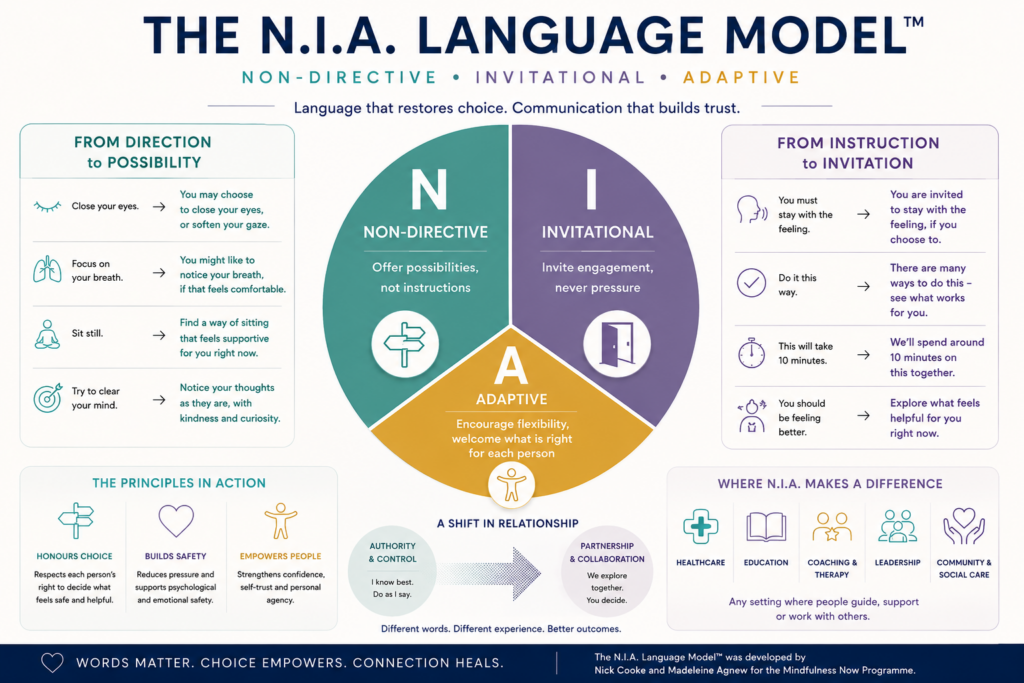
“You may wish to close your eyes or simply soften your gaze.”
Choice increases both comfort and psychological safety.
Reduce Sensory Demands
Traditional mindfulness environments often include candles, incense, background music or dim lighting.
For some autistic people these can actually increase sensory overload.
A calm environment isn’t the same for everyone.
Embrace Movement
Stillness is not essential for mindfulness.
Many autistic participants engage more comfortably through:
- Walking meditation
- Mindful movement
- Stretching
- Sensory awareness practices
- Mindful drawing or colouring
Mindfulness is about awareness—not sitting perfectly still.
Keep Sessions Predictable
Many autistic people find reassurance in knowing what to expect.
Explaining the structure of the session beforehand can significantly reduce anxiety and help participants feel more settled.

Becoming an Autism-Friendly Mindfulness Teacher
Being autism-friendly isn’t about becoming an autism specialist.
It’s about becoming a more responsive, inclusive teacher.
Autism-friendly mindfulness teachers:
- Welcome different ways of practising
- Avoid assumptions about participants
- Respect sensory needs
- Encourage autonomy
- Normalise movement and breaks
- Create psychologically safe environments
- Understand that every autistic person is different
These approaches don’t only benefit autistic participants—they often improve the experience for everyone in the room.
Why This Matters for Mindfulness Teachers
As mindfulness teaching continues to grow, maintaining high professional standards is essential. The Mindfulness Teachers Association (MTA) promotes ethical, evidence-based mindfulness teaching and provides a professional register for teachers who have completed recognised, accredited training. Choosing accredited training and engaging in ongoing CPD helps ensure mindfulness is delivered safely, inclusively and with integrity.
Why This Matters More Than Ever
Neurodiversity is becoming an increasingly important conversation across education, healthcare, workplaces and community wellbeing.
As more autistic people seek mindfulness, teachers need the confidence to adapt their teaching without compromising the integrity of mindfulness practice.
Research increasingly supports neurodiversity-affirming approaches that work with autistic ways of experiencing the world, rather than trying to reduce or “normalise” autistic traits.
Inclusive mindfulness is not about lowering standards.
It is about removing unnecessary barriers so more people can benefit from mindfulness in a way that feels safe, respectful and meaningful.

Discover our accredited Mindfulness Teacher Training and Mindfulness and Neurodiversity CPD Day to learn how you can make mindfulness truly accessible for everyone.
Building Your Confidence with Mindfulness Now
At Mindfulness Now, accessibility and inclusion are at the heart of our training.
We believe mindfulness should be available to everyone, which is why our Mindfulness Teacher Training places a strong emphasis on creating autism-friendly, neurodiversity-affirming learning environments.
For qualified mindfulness teachers wanting to deepen their knowledge, our Mindfulness and Neurodiversity CPD Day explores the latest research and practical strategies for adapting mindfulness for autistic people and other neurodivergent communities.
During the CPD day you’ll explore:
- Current evidence on mindfulness and neurodiversity
- Understanding autism and ADHD through a neurodiversity-affirming lens
- Practical adaptations for mindfulness teaching
- Creating inclusive, trauma-informed mindfulness sessions
- Building confidence to work with diverse groups in schools, workplaces, healthcare and community settings
Whether you’re beginning your teaching journey or expanding your professional practice, learning to deliver accessible mindfulness is one of the most valuable investments you can make—for both your participants and your own development as a teacher.
Frequently Asked Questions
Can autistic people benefit from mindfulness?
Yes. Research suggests adapted mindfulness programmes can support emotional regulation, reduce anxiety and improve wellbeing, although practices should always be tailored to the individual.
How can mindfulness teachers make sessions autism-friendly?
By using clear language, offering choice, reducing sensory demands, allowing movement, keeping sessions predictable and taking a neurodiversity-affirming, trauma-informed approach.
Why is autism-friendly mindfulness important?
Inclusive teaching enables more people to benefit from mindfulness while respecting different ways of thinking, communicating and experiencing the world.
Looking Forward
As mindfulness continues to grow worldwide, accessibility and inclusivity are becoming increasingly important conversations.
Mindfulness Now believes that evidence-based mindfulness should be available to everyone—not only those who can fit comfortably within traditional delivery models.
Through flexible programme design, adaptive teaching practices, and the innovative NIA language communication framework, Mindfulness Now seeks to create learning environments where people feel welcomed, empowered, and supported.
Because mindfulness is not about fitting people into a programme.
It is about creating programmes that can meet people where they are.
And that may be one of the most mindful approaches of all.

Research on Mindfulness and Autism
1. National Autistic Society (UK)
A trusted UK charity with extensive information about autism, wellbeing and support.
Suggested anchor text:
- The National Autistic Society explains more about autism and neurodiversity.
- According to the National Autistic Society…
2. NHS – Autism
Useful for readers wanting evidence-based information about autism.
🔗 https://www.nhs.uk/conditions/autism/
Anchor text:
- Learn more about autism on the NHS website.
3. NICE Guidelines – Autism
Excellent authority for healthcare recommendations.
🔗 https://www.nice.org.uk/guidance
(Search “Autism”)
Anchor text:
- NICE guidelines on autism recommend person-centred approaches.
4. Springer Nature – Systematic Review of Mindfulness for Autistic Adults
Kiep M, Spek AA, Hoeben L. (2015 and later reviews)
One recent review:
🔗 https://link.springer.com/article/10.1007/s40489-023-00398-y
Anchor text:
- A recent systematic review found encouraging evidence for adapted mindfulness interventions.
5. PubMed
Mindfulness and autism research database
🔗 https://pubmed.ncbi.nlm.nih.gov/?term=mindfulness+autism
Anchor text:
- Numerous studies exploring mindfulness and autism are available via PubMed.
Neurodiversity Resources
Neurodiversity Hub
Excellent evidence-based educational resource.
🔗 https://www.neurodiversityhub.org
Anchor text:
- The Neurodiversity Hub provides evidence-informed resources on neurodiversity.
British Psychological Society
Often publishes articles on neurodiversity and autism.
Mindfulness Research
Oxford Mindfulness Foundation
🔗 https://www.oxfordmindfulness.org
One of the world’s leading mindfulness organisations.
Bangor University Centre for Mindfulness Research and Practice
🔗 https://www.bangor.ac.uk/mindfulness
Very well respected in the UK.
The British Association of Mindfulness-Based Approaches (BAMBA)
Excellent authority for mindfulness teaching standards.
Mindfulness Teachers Association (MTA)
The UK’s largest professional body and register for accredited mindfulness teachers, promoting ethical, evidence-based practice and continuing professional development.