

Mindfulness Supervision

Mindfulness Supervision at the UK College of Mindfulness Meditation

A Supportive Space for Growth, Reflection and Connection

At the UK College of Mindfulness Meditation, we believe that supervision is much more than a professional requirement — it’s a living, breathing part of the mindfulness journey. It’s a space of warmth, curiosity, and compassion, where teachers and trainees can pause, reflect, and reconnect with the heart of their practice.

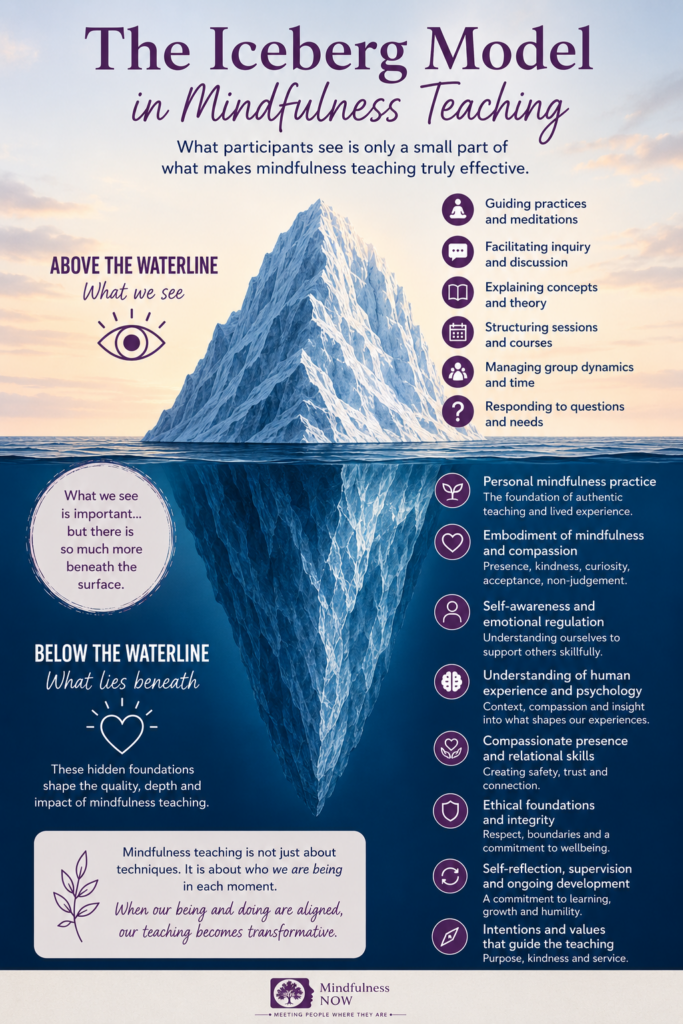
Mindfulness supervision offers time to explore both the joys and challenges of teaching, to deepen understanding, and to nurture the integrity that underpins good mindfulness practice. It supports teachers in bringing authenticity and awareness into their work — and into their lives.

What Mindfulness Supervision Means to Us

Supervision is a regular, collaborative relationship between supervisor and supervisee, built on trust and shared intention. Together, they explore the supervisee’s teaching experiences, reflect on personal practice, and consider how mindfulness flows through both their work and daily life.

This process helps teachers to:

  • Stay grounded and authentic in their teaching.

  • Reflect on their development in a safe, supportive space.

  • Maintain good practice and ethical awareness.

  • Strengthen the bridge between personal mindfulness practice and professional teaching.

In every supervision relationship, our goal is to nurture confidence, compassion, and clarity — helping teachers grow in both skill and self-understanding.


The People Behind the Practice

Our supervisors are at the heart of what we do. Each one brings a wealth of experience, depth of practice, and genuine care for the people they support. All are:

  • Experienced mindfulness teachers, having taught at least 10 full 8-week courses over a minimum of three years.

  • Proficient and assessed teachers, often using frameworks such as the Mindfulness-Based Interventions: Teaching Assessment Criteria (MBI:TAC).

  • Ongoing practitioners, who continue to teach mindfulness courses alongside their supervisory work.

This ensures that every supervisee is guided by someone who truly lives and breathes mindfulness — not only as a professional skill but as a way of being.

The Spirit of Supervision

Supervision at the UK College follows an enquiry-led approach — one rooted in mindfulness itself. Sessions are reflective, compassionate and open, encouraging supervisees to explore their experiences rather than seek quick answers.

Through this process, supervisors help teachers to:

  • Discover new insights into their teaching.

  • Identify areas of strength and growth.

  • Reconnect with the intentions behind their work.

  • Hold challenges with awareness and kindness.

Our supervisors draw on their own practice and presence to create a space that is safe, non-judgmental and gently challenging — the kind of environment where real learning and transformation can unfold.


Commitment to Depth and Integrity

To ensure the highest quality of supervision, our supervisors are continuously developing their own practice. Each one:

  • Takes part in regular supervision of supervision.

  • Attends annual retreats, often 7–14 days in duration, to deepen practice and presence.

  • Keeps up to date with the latest research and evidence in mindfulness and supervision.

  • Engages in ongoing study, reading and reflection, often guided by experienced mindfulness teachers.

This commitment to ongoing development ensures that supervision within the College remains rooted, evolving, and aligned with both tradition and modern understanding.


Working with Compassion and Ethics

Our supervisors approach every relationship with warmth, respect and integrity. They are skilled in balancing the educational, supportive and ethical aspects of supervision — helping teachers feel both safe and stretched.

They offer:

  • Honest, constructive feedback that supports growth.

  • Clear boundaries and professionalism.

  • Sensitivity to diversity and individual experience.

  • A deep understanding of how personal mindfulness practice informs professional life.

When supervision includes clinical contexts, we ensure that clinical responsibility remains clearly defined and, where appropriate, supported by a separate clinical supervisor.

Quality and Care at Every Level

The UK College of Mindfulness Meditation is proud to uphold a culture of quality, reflection, and compassion. We take care to ensure that all supervision offered through the College reflects the same standards of authenticity and integrity that define our teacher training.

We do this through:

  • Careful selection, training, and mentoring of supervisors.

  • Peer reflection and team dialogue to share learning and ensure consistency.

  • Regular review and continuing professional development (CPD).

Our approach ensures that every supervision relationship — whether for a new trainee or an experienced teacher — is supportive, ethical, and deeply aligned with the heart of mindfulness.


Supporting You on Your Teaching Journey

Supervision is where mindfulness teaching truly takes root — where practice meets experience, and understanding grows from reflection.

Whether you’re beginning your teaching journey or refining your skills after years of experience, our supervision team is here to walk alongside you.

At the UK College of Mindfulness Meditation, supervision is not just guidance — it’s a shared mindfulness journey. A chance to stay connected, stay inspired, and continue growing in presence and compassion.


The 10 Attitudes of Compassion – Embracing the Yin and Yang of Compassionate Practice

The 10 Attitudes of Compassion

Balancing the Yin and Yang of Compassionate Practice

The 10 Attitudes of Compassion were developed by Madeleine Agnew and Nick Cooke as a core teaching element within the CFW (Compassion Focused Wellbeing) Programme. Designed to support participants in exploring the deeper foundations of compassionate living, these attitudes act as guiding principles—helping us both cultivate compassion and recognise it as a natural capacity already present within us.

Just as mindfulness has its attitudes, compassion too has its inner qualities—some gentle and soothing (Yin), others protective and powerful (Yang). To live compassionately is to learn how to hold both energies in balance: the softness that allows us to feel, and the strength that empowers us to act.

Like planting seeds in fertile soil, we begin by consciously nurturing these attitudes—practising kindness, building courage, learning to connect, and so on. At first, they may feel intentional, deliberate, even effortful. But over time, something subtle begins to shift. These attitudes stop feeling like things we’re trying to do and instead become qualities that rise naturally from within us—the fruits of a compassionate way of being.

In this way, the attitudes serve a dual purpose:

  • They guide us—helping us develop inner resilience, tenderness, and wisdom.

  • They reflect our growth—emerging effortlessly as signs of a compassionate heart in motion.

Just as mindfulness deepens through its attitudes, compassion matures through these qualities, revealing both the Yin (soft, receptive, nurturing) and the Yang (strong, protective, active) expressions of the compassionate life. True compassion is not one or the other—it is the dance between both.

To live compassionately is to learn how to hold both energies in balance: the softness that allows us to feel, and the strength that empowers us to act.


1. Courage – Yang

Recognising suffering takes bravery. Turning towards rather than away is the first step of compassion. Courage is not the absence of fear; it is the willingness to stay present with vulnerability, both in ourselves and others. It’s often the beginning of the compassionate journey.


2. Kindness – Yin

Kindness is the heartbeat of compassion, though it is often underestimated in its power. Soft, quiet, and nourishing, kindness allows us to meet pain with warmth rather than harshness. It is a gesture of care, whether expressed outwardly to others or inwardly towards ourselves.


3. Connection – Yin

Compassion awakens when we feel connected—to our inner experience and to the shared humanity of others. Through authentic connection and compassionate listening, we create safe spaces where suffering can be witnessed rather than hidden. Connection reminds us: we are not alone in this.


4. Wisdom – Yin & Yang

Wisdom helps us discern compassionate action from reaction. It invites reflection, self-honesty, and awareness. As Paul Gilbert reminds us, “Compassion without wisdom may be misguided, and courage without wisdom can become reckless.” Wisdom helps us act with clarity and integrity.


5. Assertiveness – Yang

Compassion is not passive. Assertiveness is its fierce expression—the willingness to set boundaries, speak truth, and honour our own needs without aggression. Assertive compassion says, “I matter too. I am worthy of care.” It protects what is sacred within us.


6. Tolerance – Yin

Tolerance is the spaciousness to hold discomfort, difference and uncertainty without immediate judgment or rejection. It is more than endurance—it is an active willingness to stay open-hearted, allowing growth and greater understanding to emerge.


7. Action – Yang

Compassion calls us not only to feel but to respond. Action is compassion in motion—a step, however small, towards easing suffering. Yet compassionate action is thoughtful, guided by kindness and wisdom rather than urgency or guilt.


8. Forgiveness – Yin

Forgiveness softens the grip of resentment and self-criticism. It does not deny harm but creates space for healing. Through forgiveness, we release the armour of blame and open the door to freedom, both for ourselves and others.


9. Love – Yin & Yang

Love lives at the centre of compassion. It is both gentle and strong, tender and courageous. To love compassionately is to recognise the worth and dignity of all beings, including ourselves. Love invites us to hold suffering not with pity, but with reverence and care.


10. Gratitude – Yin

Gratitude is the art of noticing. Even amidst pain, it invites us to acknowledge what is still nourishing, beautiful, or steady. Gratitude rewires us towards balance, reminding us that alongside struggle, there is still grace.

Become a Teacher of Compassion Focused Wellbeing

For mindfulness teachers looking to integrate compassion more formally into their work, the Compassion Focused Wellbeing (CFW) teacher training programme is an excellent next step.

Created by Nick Cooke and Madeleine Agnew, this UK-based accredited course combines the latest insights from Compassion Focused Therapy (CFT), Mindful Self-Compassion (MSC), and the Mindfulness Now programme (which blends MBSR and MBCT). It’s trauma-informed, research-based, and incredibly practical.

Graduates become part of a growing community of licensed and accredited CFW teachers, equipped to deliver compassion-focused courses, retreats, and one-to-one sessions.

Living the Attitudes

These attitudes are not fixed traits but living practices—qualities that grow with time, intention and self-reflection. Some days, compassion asks us to soften. Other days, it asks us to rise. To walk the compassionate path is to continually dance between Yin and Yang—between gentle acceptance and empowered action.

Ready to Learn More?

Explore the Compassion Focused Wellbeing Teacher Training with the UK College of Mindfulness Meditation and take your mindfulness teaching to the next level.

Useful Links & References

  • CFW Compassion Focused Wellbeing https://mindfulnessnow.org.uk/compassion-focused-wellbeing/

  • Paul Gilbert – The Compassionate Mind

  • Dr. Kristin Neff – Fierce Self-Compassion

  • www.compassionatemind.co.uk

  • www.chrisgermer.com

  • www.centerformsc.org (Mindful Self-Compassion resources)

  • TED Talk: The Power of Vulnerability – Brené Brown

  • Neff, K. (2003). Self-Compassion: An Alternative Conceptualization of a Healthy Attitude Toward One

From Safe Space to Brave Space: A Mindfulness Teacher’s Call to Compassionate Courage

From Safe Space to Brave Space

A Mindfulness Teacher’s Call to Compassionate Courage

Within mindfulness and compassion teaching, much emphasis is placed on creating safe space—a container of presence where participants are invited to arrive as they are. Yet the world in which we teach is not always safe. It is marked by grief, injustice, and collective trauma that enter the room with every participant. In such a climate, the invitation is not only to create safety, but to evolve that safety into brave space—a space where truth, vulnerability, and justice-centered compassion are welcomed and held with care. There is a deeper invitation available to us: to nurture such a profound inner safety that it becomes the foundation from which we step into the world with courage, truth, and compassionate action. Safe space, when embodied, naturally evolves into brave space.

The First Safe Space Is the One Within

Humans are hard-wired for safety. Before we can be brave, we must feel rooted enough to withstand discomfort, complexity, and difference.

Cultivating that inner refuge begins not with perfection, but with curiosity. With knowledge. With a willingness to see ourselves clearly.

A Short Guided Practice: From Safe to Brave

1. Find your posture—sitting, standing, or lying down. Place your hands softly where they feel at ease.

2. Notice. Breath, sensations, subtle shifts. No need to fix anything—just witness.

3. Inhale slowly through the nose. Fill to the top. Pause. Feel your strength.
Exhale gently through the mouth, drawing the belly inward. Pause. Begin again.

4. Return to a natural rhythm. Notice the transition between breaths. Let your body be a safe place.

5. On the next breath, bring your palms together at your heart. Imagine holding something fragile and sacred. Feel tenderness.

6. Open the palms toward your chest like a mirror. Let your hands reflect the truth and compassion living in your heart right now.

7. Gently close the palms again, holding your intention. Soften your body.

8. Open your eyes or let them brighten if already open. Inhale into the safe space you have created. Feel its presence inside you.

9. Let your hands lift above your head, then circle outward and back toward your heart—expanding your field of safety into a wider brave space.

Here, in this breath, bravery lives.


Teaching in Times of Collective Pain

Moments of societal crisis—especially those involving racialised violence and systemic injustice—bring heightened emotional charge into the learning space. Participants may arrive with grief, outrage, numbness, fear, or weariness. Teachers, too, carry their own responses. Rather than suppressing or bypassing these realities, mindful facilitation invites grounded acknowledgement.

This approach aligns with the spirit of “Brave Space” articulated by community facilitator Micky ScottBey Jones, whose poem An Invitation to Brave Space emphasises that while no space can be entirely safe, it can be held with courage, love, and collective responsibility. The poem encourages practitioners to stand together in the imperfect work of healing, rather than seeking protection through silence. (Link included in the resource section below.)

Naming Suffering Without Causing Harm

Injustice and systemic oppression cannot be addressed through silence. For many mindfulness teachers, especially those navigating racial dynamics or confronting their own social conditioning, there can be a hesitancy to speak. However, unacknowledged suffering often deepens harm.

A justice-informed teaching approach encourages:

  • Awareness before intervention — Teachers first attune to their internal responses to suffering and injustice.

  • Acknowledgment over avoidance — Naming the presence of pain in the room without centering personal discomfort.

  • Enquiry over certainty — Asking with humility rather than teaching from authority.

  • Compassionate witnessing — Allowing participants’ experiences to be held with respect and without defensiveness.

A brave space does not demand disclosure or emotional labor from marginalised participants. Instead, it creates conditions where what needs to be spoken can be spoken, and where silence can also be honored as a form of self-protection and agency.

Embodied Practice: Moving From Safe to Brave

Mindfulness teachers can support this transition through practices that ground participants in the body before engaging in dialogue. Simple forms of breath awareness, compassionate hand placement at the heart, or visualising safety within the body can establish enough internal stability to approach difficult truths with less reactivity.

Embodying safety allows teachers and participants alike to approach conversations about injustice not as intellectual debates but as felt experiences—rooted in humanity, dignity, and shared presence.

Toward a Compassionate Pedagogy of Justice

The work of building brave spaces in mindfulness teaching is not about perfection. It is about presence, responsibility, and an unwavering commitment to hold suffering with compassion while refusing to turn away from the systems that create it.

A justice-centered mindfulness pedagogy recognizes that:

  • Inner refuge supports outer courage.

  • Self-compassion fuels resilience for sustained engagement.

  • Naming suffering is a necessary step toward collective healing.

  • Brave space is co-created through humility, listening, and care.

As teachers, the invitation is to continue cultivating our own safe inner spaces while extending that safety outward in the form of courageous, compassionate action. In this way, mindfulness is not withdrawn from the world, but is deeply responsive to it.

Resources for Further Study and Teaching

An Invitation to Brave Space — Micky ScottBey Jones
https://onbeing.org/poetry/an-invitation-to-brave-space/
A grounding poem widely used in justice-centered facilitation. Useful to open or close mindfulness sessions dealing with vulnerability and collective suffering.

The Inner Work of Racial Justice — Rhonda V. Magee
https://www.rhondavmagee.com/
Explores how mindfulness and compassion practices can support racial awareness, healing, and social transformation. A key text for mindfulness teachers engaging with justice work.

White Awake – Educational Resources on Race and Mindfulness
https://whiteawake.org/
Offers mindfulness-based workshops and resources specifically for those racialized as white to understand conditioning, privilege, and how to hold space responsibly.

Anguish and Action – Obama Foundation
https://www.obama.org/anguish-and-action/
Provides educational resources and calls to action related to racial justice, designed to support those seeking to move from awareness into meaningful engagement.

How I Learned to Stop Worrying and Love Talking About Race — TEDx Talk
(Search: title + TEDx)
A talk encouraging self-compassion and courage when engaging in conversations on race—helpful for teachers navigating fear of saying the wrong thing.

Trauma-Informed Mindfulness Toolkit — Center for Trauma & Embodiment
https://www.traumasensitiveyoga.com/resources
A collection of resources on creating safer facilitation environments, integrating somatic awareness, and avoiding re-traumatization in mindfulness spaces.

Rhonda Magee on Mindfulness and Race — On Being Interview
https://onbeing.org/programs/rhonda-magee-mindfulness-and-racial-healing/
A deeply reflective conversation on how inner practice meets systemic suffering, suitable for teacher inquiry and reflection.

Black Liturgies — Cole Arthur Riley
https://www.instagram.com/blackliturgist/
A contemplative practice archive rooted in Black liberation theology and embodied spiritual care. Offers language for holding sorrow and resistance in sacred space.

Mindfulness in Movement Spaces — BIPOC-Centered Facilitation Tools
(Search community-based organizations like The Nap Ministry, Healing Justice Lineages)
Provides examples of how rest, embodied presence, and mindfulness are being reclaimed in activist and BIPOC-led healing traditions.

The History and Origins of Mindfulness

The History and Origins of Mindfulness

Explore mindfulness, from the buddha, to yoga and it's great journey to the western world.

Mindfulness is often thought of as a modern wellbeing practice, but its history stretches back thousands of years. At its heart, mindfulness is the simple yet profound act of paying attention to the present moment with openness, curiosity, and acceptance. While today it is often taught in secular settings—such as schools, workplaces, and healthcare—it has deep spiritual and philosophical roots in ancient traditions.

Ancient Beginnings

Mindfulness can be traced back to early Indian traditions, most notably Hinduism and Buddhism. Both traditions placed emphasis on awareness, meditation, and the cultivation of presence as a way of living in harmony with the world.

Hinduism and the Vedic Tradition

Hinduism is one of the oldest surviving religious traditions, with origins reaching back over 4,000 years. Within the Vedic texts, we find early references to meditation, breath awareness, and practices designed to steady the mind. These were seen as pathways to self-realisation and union with the divine. Texts such as the Bhagavad Gita speak of living with focus, balance, and discipline—principles that strongly resemble what we now describe as mindfulness.

The Buddha and the Central Role of Mindfulness

Around 2,500 years ago, Siddhartha Gautama—the Buddha—developed teachings that placed mindfulness (sati in Pali) at the very centre of the path to liberation. In Buddhism, mindfulness is one of the steps of the Noble Eightfold Path, described as the way to reduce suffering and cultivate wisdom.

Here, mindfulness was not just a practice for quiet moments on a meditation cushion, but a way of living: being aware of one’s body, feelings, thoughts, and surroundings in each moment. This understanding of mindfulness as both a meditative practice and a guiding principle for daily life has shaped how it has been taught across generations.

Mindfulness and Yoga

Yoga, which also has its roots in the Indian tradition, overlaps significantly with mindfulness. Beyond the postures that are so well known in the West today, yoga has always been a wider philosophy aimed at uniting body, mind, and spirit. Many yoga practices, such as breath awareness (pranayama) and meditation, are essentially mindfulness in action.

Research today continues to show that people who practise yoga often report higher levels of mindfulness, demonstrating the close relationship between these two ancient paths.


The Journey to the West

While mindfulness has been practised in Eastern cultures for thousands of years, its introduction to the West has been more recent. From the mid-20th century onwards, teachers such as Thich Nhat Hanh, a Vietnamese Zen master, began to share mindfulness in accessible ways that could be understood outside of a Buddhist framework. His writings and teachings brought mindfulness into everyday language, with an emphasis on compassion and simple, daily practice.

Another key figure in this journey was Jon Kabat-Zinn, who studied with Buddhist teachers and later developed Mindfulness-Based Stress Reduction (MBSR) in the late 1970s. His work helped bridge Eastern wisdom with Western science, opening the door for mindfulness to be used in hospitals, schools, and beyond.

Alongside Kabat-Zinn, teachers like Jack Kornfield, Sharon Salzberg, and Joseph Goldstein founded centres such as the Insight Meditation Society, helping to embed mindfulness practice in Western contexts while keeping its Buddhist roots visible.

A Universal Human Practice

Although Buddhism and Hinduism are often highlighted in discussions of mindfulness, it is important to remember that similar practices of contemplation and presence exist across many traditions. In Christianity, Judaism, and Islam, there are forms of prayer and reflection that encourage present-moment awareness. This shows that mindfulness is not exclusive to any one religion, but rather a universal human capacity that can be nurtured in many different ways.

Mindfulness Today

Today, mindfulness is taught in a wide variety of settings—from meditation centres to community groups, schools, and healthcare services. For some, it is a spiritual path; for others, it is a practical tool for reducing stress and cultivating wellbeing. What remains constant is the essence: bringing awareness to the here and now, with kindness and curiosity.

A Takeaway

When we practise mindfulness today, we are joining a lineage that stretches back thousands of years. Whether it is through quiet meditation, mindful breathing, or simply paying attention as we wash the dishes, we are taking part in a tradition that has been passed from generation to generation.

Mindfulness, at its heart, is about being fully alive in the present moment. Its history may be long and complex, but its practice remains beautifully simple.


Further Reading and Resources

Here are some excellent places to explore the history, philosophy, and practice of mindfulness in more depth:

Mindfulness & Neurodivergence: What to Know, What to Watch Out For, and What to Do

Mindfulness & Neurodivergence

What to Know, What to Watch Out For, and What to Do

If you’re teaching mindfulness, you probably already know how powerful it can be. But working with neurodivergent people sometimes means rethinking the usual assumptions, adapting things, and being extra attentive to how our participants are experiencing the practice. Here are some of the things you might want to think about, and some simple tweaks to help the group stay connected, safe, and benefitting.

What the Research & Lived Experience Suggest

Before jumping into the “how,” it helps to know what studies and people are telling us.

  • Feasibility and benefit: Mindfulness-Based Stress Reduction (MBSR) adapted for autistic adults shows it can be acceptable, feasible, and helpful — with reduced stress and better coping (PMC study).

  • Potential adverse effects: Some neurodivergent people report that certain practices worsened anxiety or felt overwhelming (Mindful.org).

  • Sensory & attention differences are key: things like sensory overload, fidgeting, or needing to move can strongly influence how mindfulness is experienced (Time Timer blog).

  • Adaptations improve outcomes: shorter practices, clearer structure, sensory adjustments, and flexible delivery often make mindfulness more accessible (Autistica research).

Potential Pitfalls You Might Run Into

  1. “Stillness = peace” assumption — long silent sits can feel like distress, not calm (Autism Research Institute).

  2. Ambiguous instructions — metaphors may confuse more literal thinkers (ADDitude Magazine on ADHD & mindfulness).

  3. Sensory overload — light, sound, smell, temperature can derail focus (NHS Autism sensory differences).

  4. Emotional overwhelm — mindfulness can bring up trauma or dysregulated states (Frontiers in Psychology: Adverse effects).

  5. Attention/executive function challenges — difficulty sustaining practice between sessions (CHADD on ADHD mindfulness).

  6. Fear of failing — feeling they’re “bad” at mindfulness when the mind wanders (American Mindfulness Research Association).

Some Simple Steps & Tricks You Might Try

  • Shorten practices: Try 3–5 minutes rather than 20. (Psychology Today)

  • Movement options: Walking meditation, yoga, even pacing or fidgeting can count (Harvard Health).

  • Sensory-friendly environments: adjust lighting, allow headphones/earplugs, comfortable seating (National Autistic Society).

  • Clear, literal instructions: avoid heavy metaphors; offer concrete anchors like “notice where your feet touch the floor.”

  • Structure & predictability: give written outlines, visual schedules, time warnings (Autistic Self Advocacy Network).

  • Normalize variation: remind people there’s no “right” way. (Mindful.org).

  • Adapt homework: micro practices, daily-life mindfulness, phone reminders. (Greater Good Science Center).

Why It Matters

When you adapt, you’ll likely see:

  • Better attendance & retention

  • More comfort and safety in the group

  • Deeper engagement and less dropout

  • A richer, more inclusive mindfulness space

And truthfully — these changes help everyone, not just neurodivergent participants.