



For many years, mindfulness teaching has focused on helping people cultivate awareness, presence, and compassion. Yet as the field has grown, an important question has emerged:
Who is mindfulness truly accessible to?
While mindfulness is often presented as a universal practice, the language used by teachers can unintentionally exclude, marginalise, or even retraumatise some learners. Instructions that assume certain experiences, abilities, beliefs, or levels of emotional safety can create barriers rather than pathways into practice.
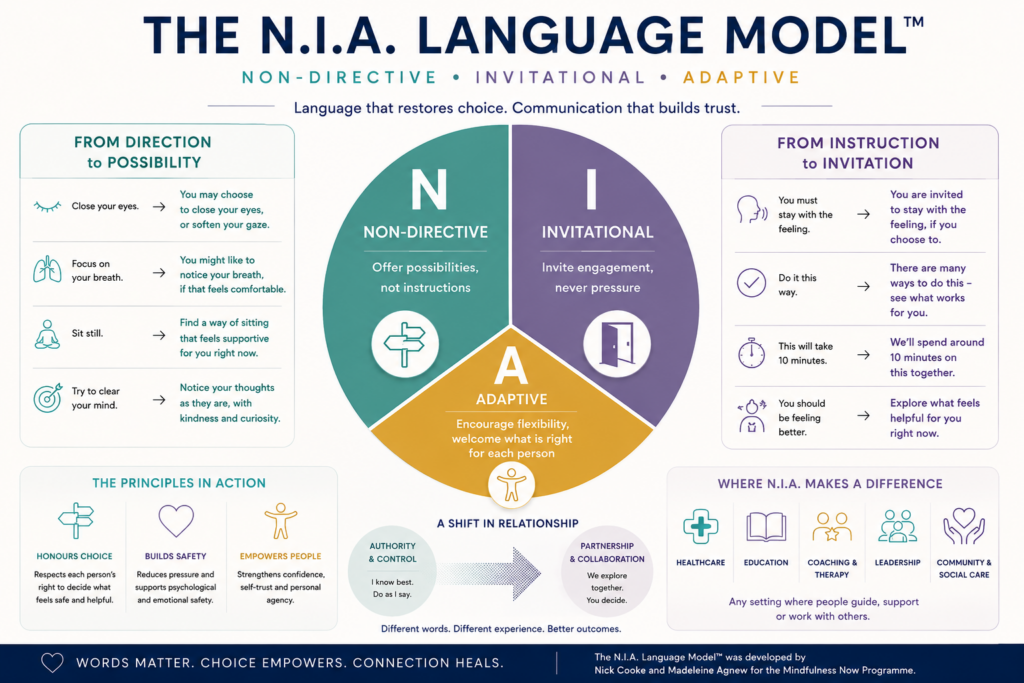
This challenge led to the development of the N.I.A. Language Model—a framework designed to make mindfulness teaching genuinely inclusive, accessible, and responsive to the diverse needs of all learners.
Today, the N.I.A. Language Model has become recognised as the universal language of accessible mindfulness teaching. It represents a new frontier in mindfulness education, placing choice, flexibility, and accessibility at the centre of practice.
The development of the N.I.A. Language Model emerged from a growing understanding that mindfulness is not experienced in the same way by everyone.
Every learner arrives with their own:
Traditional mindfulness language often assumes that participants can comfortably close their eyes, focus on bodily sensations, remain still, or explore difficult emotions. For many people, these invitations may feel supportive. For others, they may feel overwhelming, unsafe, or inaccessible.
Research and lived experience have increasingly shown that mindfulness teaching must move beyond a “one-size-fits-all” approach.
The N.I.A. Language Model was developed to address this need.

Its purpose is simple:
To ensure that mindfulness can be safely and meaningfully accessed by all people, regardless of background, circumstance, identity, or previous experience.
Developed by Nick Cooke and Madeleine Agnew, the N.I.A. Language Model was created to make mindfulness teaching more accessible, inclusive, and choice-led for all learners.

Historically, accessibility has often been treated as an adaptation added after a course has been designed.
The N.I.A. approach challenges this thinking.
Accessibility is not something that sits on the edge of mindfulness teaching.
Accessibility is the foundation.
The model encourages teachers to use language that provides genuine options rather than instructions that imply there is only one correct way to practise.
Instead of saying:
“Close your eyes and focus on your breath.”
A N.I.A.-informed teacher might say:
“If it feels comfortable, you might choose to close your eyes, soften your gaze, or simply look around the room. You may notice your breath or any other experience that feels supportive right now.”
The difference may appear subtle, but it is profound.
The learner remains in control.
The learner retains agency.
The learner has choice.
One of the most important reasons for developing the N.I.A. Language Model was the recognition that mindfulness practices can sometimes unintentionally contribute to retraumatisation.
For individuals who have experienced trauma, certain instructions may trigger distressing memories, sensations, or emotional responses.
Without accessible language, learners may feel:
When mindfulness is presented as something that must be done in a particular way, participants can feel that they are “failing” if that approach does not work for them.
The N.I.A. Language Model replaces prescription with invitation.
It creates space for learners to engage in ways that feel appropriate and safe for them.
Rather than demanding compliance, it promotes autonomy.
Rather than assuming readiness, it offers options.
This shift helps reduce the risk of retraumatisation while supporting emotional safety and psychological wellbeing.

In this sense, N.I.A. is not simply a communication technique.
It is a philosophy of teaching.
It reflects a belief that mindfulness should belong to everyone.
As mindfulness has evolved, the N.I.A. Language Model has increasingly become recognised as a universal language for accessible mindfulness teaching.
This is because it transcends individual teaching styles and traditions.
Whether teaching:
The principles remain the same.
The language honours diversity.
The language centres choice.
The language supports inclusion.
The language respects lived experience.
One of the most powerful insights underpinning the N.I.A. Language Model is that people engage more effectively when they feel empowered.
When learners are offered meaningful choices, they are more likely to:
Choice is not about lowering standards or reducing the depth of practice.
Instead, it recognises that there are many pathways into mindful awareness.
A learner may connect through:
The N.I.A. approach honours all of these possibilities.
Many mindfulness programmes strive to be inclusive.
The N.I.A. Language Model goes further.
Its goal is to foster belonging.
Inclusion says:
“You are welcome here.”
Belonging says:
“This space was designed with you in mind.”
When learners hear language that reflects their needs, respects their boundaries, and acknowledges their autonomy, mindfulness becomes something they can genuinely access.
They no longer have to adapt themselves to fit the practice.
The practice adapts to support them.
The emergence of the N.I.A. Language Model marks a significant step forward in the evolution of mindfulness education.
As understanding grows around trauma awareness, neurodiversity, accessibility, and inclusive practice, teachers are increasingly recognising that language matters.
Words shape experience.
Words create safety.
Words influence belonging.
The future of mindfulness teaching lies not in asking people to fit into a predetermined model of practice, but in creating practices that honour the diversity of human experience.
The N.I.A. Language Model provides the framework for this future.
It offers a universal language that places accessibility, flexibility, and genuine choice at the heart of mindfulness teaching.
Without such an approach, learners may remain vulnerable to exclusion, marginalisation, or retraumatisation. Mindfulness can become inaccessible to those who may benefit from it most.

With the N.I.A. Language Model, mindfulness becomes what it was always intended to be:
A practice for everyone.
Regardless of background.
Regardless of identity.
Regardless of previous learning.
Regardless of ability.
A mindfulness practice built on choice, accessibility, and belonging.
A truly universal mindfulness language for all.
If you would like to explore the themes of accessible mindfulness, trauma-informed practice, inclusion, and mindfulness teaching in more depth, the following organisations and resources provide valuable information and guidance.